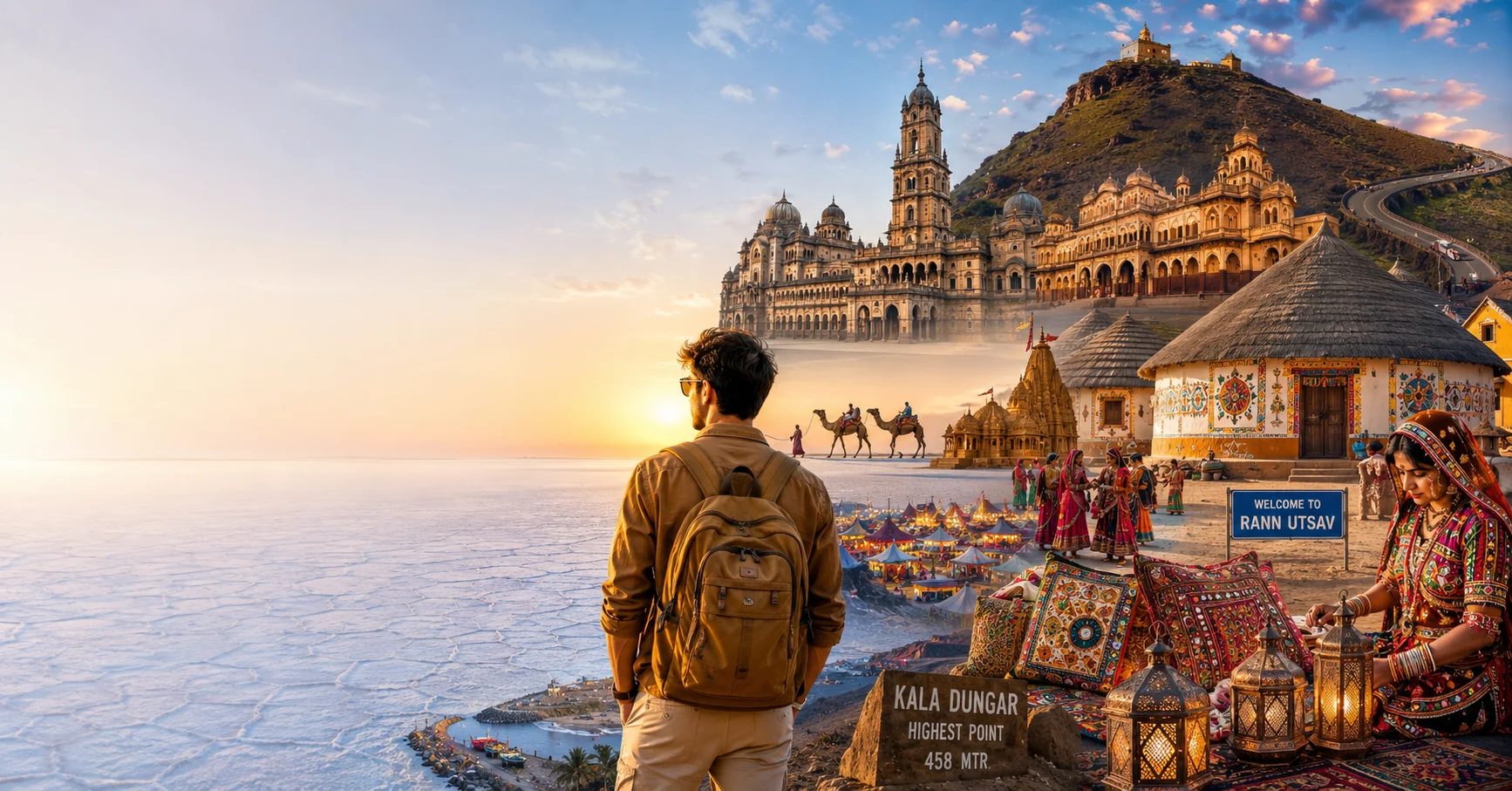
Bhuj is the kind of city that punishes impatience. Most travelers arrive, photograph Prag Mahal, drive to the Rann of Kutch, and leave with the feeling that they have seen it.
They have seen almost nothing. Places to visit in Bhuj span palace architecture that rivals Rajasthan, a world-class earthquake museum that most Indians have not heard of, living craft traditions that exist nowhere else on earth, and day trips to one of the oldest civilizations ever excavated.
Furthermore, Bhuj is the capital of Kutch, one of the largest districts in India by area. Most notably, the cultural density packed into this desert city makes it one of the most genuinely rewarding destinations in Gujarat for travelers who take the time to understand what they are looking at.
This guide covers all 18 with honest assessments, actual entry fees, and the kind of practical detail that turns a good Bhuj trip into a genuinely memorable one.
What You Will Learn
- The 18 best places to visit in Bhuj across heritage, nature, and culture
- Honest entry fees, timings, and distances for every Bhuj tourist attraction
- Best places in Bhuj for families, couples, history lovers, and nature seekers
- The best time to visit Bhuj and which season suits which traveler type
- Free versus paid Bhuj famous places and how to budget your visit
- 2-day, 3-day, and extended Kutch itineraries that actually make geographic sense
Why Bhuj Deserves More Than a Drive-Through
Bhuj was almost destroyed in January 2001 when a 7.7 magnitude earthquake killed approximately 20,000 people and left most of the old city in rubble. Furthermore, what emerged from that catastrophe is one of the most remarkable stories of cultural resilience in modern India.
The city rebuilt without abandoning its identity. Most notably, the palaces were restored, the craft traditions continued, and the Smritivan Memorial rose on Bhujiyo Hill as one of the finest museums built anywhere in India in the past two decades.
In particular, Bhuj serves as the natural base for an entire Kutch itinerary covering the Great Rann, Dholavira UNESCO World Heritage Site, Mandvi Beach, and the craft villages that make this district India’s most celebrated center of textile art. That said, the city itself contains enough to justify three full days before you ever leave the district.
Bhuj Famous Places: The Palaces That Define the City
The Bhuj famous places that most travelers have heard of are the twin palaces sitting near each other in the heart of the city. Furthermore, they represent two entirely different architectural traditions built just decades apart by the same royal family, which makes visiting both on the same morning one of the more intellectually interesting things you can do in Gujarat.
1. Aina Mahal (Hall of Mirrors)
Aina Mahal was built in the 18th century by Maharao Lakhpatji and represents one of the most extraordinary examples of cultural fusion in Indian architecture. European baroque design meets Kutchi craftsmanship in a building that should not work aesthetically but absolutely does.
Furthermore, the Hall of Mirrors inside is genuinely breathtaking. Venetian glass, Flemish tiles, and Kutchi mirror work combine in a space that the Maharao’s craftsman Ram Singh Malam created after studying in Europe for 17 years.
Most notably, a small museum on the ground floor displays royal artifacts, weapons, coins, and portraits that provide essential context before you enter the main palace rooms. Entry costs INR 10 for Indians and INR 100 for foreigners, open 9 AM to 12 PM and 3 PM to 6 PM.
That said, photography inside requires a separate camera fee, and the building’s post-earthquake repair is visible in sections. In particular, none of that diminishes the experience because what survived and what was restored remains extraordinary.
2. Prag Mahal (Italian Gothic Palace)
Prag Mahal was commissioned in 1865 by Rao Pragmalji II and completed in 1879 at a cost of 3.1 million rupees, designed by Colonel Henry Saint Wilkins in Italian Gothic style. Furthermore, nothing about Bhuj prepares you for the sight of a building with Corinthian pillars and Gothic windows rising out of the Kutch landscape.
The exterior is the main event. However, climbing the bell tower is the moment that justifies the entire visit, providing the finest accessible panoramic view of Bhuj city available from any public vantage point.
Entry costs INR 15 for Indians and the palace is open 9 AM to 12 PM and 3 PM to 6 PM. Most notably, combining Aina Mahal and Prag Mahal in a single morning, starting at Aina and finishing the bell tower climb at Prag, covers two of the most architecturally significant buildings in western India before lunch.
3. Bhujia Fort (Bhujiya Hill Fort)
Bhujia Fort was built between 1715 and 1718 by Jadeja Chief Rao Godaji on the rocky hill overlooking the city. Furthermore, six major battles were fought here over the following century between Rajput rulers, Mughal raiders, and Sindhi forces, and the fort’s walls still show the evidence.
The hike to the summit takes approximately 20 minutes from the base parking area and involves a moderate rocky path. Beyond that, the fort structure itself is largely intact and the Bhujanga snake god temple at the summit is worth visiting specifically because it explains the name Bhujia.
No entry fee, open 6 AM to 9 PM, and the early morning light on the city below is genuinely worth the 5:30 AM alarm. As a result, combining the Bhujia Fort hike with a quick Hamirsar Lake walk immediately after makes for the finest free morning in Bhuj.
4. Smritivan Earthquake Memorial and Museum
Smritivan opened in 2022 as a tribute to the 20,000 victims of the 2001 earthquake. Furthermore, describing it as a museum significantly undersells what it actually is.
Seven themed galleries across 52,000 square meters document the earthquake, the loss, the rescue, and Kutch’s extraordinary rebuilding through immersive installation art, audio-visual experiences, and architectural spaces that are themselves emotionally affecting. Most notably, the design and production quality rivals international-standard memorial museums anywhere in the world.
Entry is INR 100 for Indians and the museum is open 9 AM to 6 PM daily. In particular, allow a minimum of 2 to 3 hours and book tickets in advance on the official website because weekend queues can be significant. That said, it is the single most important Bhuj tourist attraction built in the past decade and should not be skipped under any circumstances.
Best Places to Visit in Bhuj for History and Heritage
The best places to visit in Bhuj for historically minded travelers extend well beyond the palaces. Furthermore, the city’s heritage layer includes museums, temples, and freedom movement memorials that collectively tell a story no other Indian city tells in quite the same way.
5. Kutch Museum
Gujarat’s oldest museum was established in 1877 on the banks of Hamirsar Lake and houses a collection that most visitors significantly underestimate before entering. Furthermore, Harappan artifacts, tribal textiles, stone sculptures from the first millennium, and one of the finest collections of Kutchi gold and silver jewelry in any public institution are all within these walls.
The textile collection alone justifies a visit for anyone with even passing interest in Indian craft traditions. Entry is INR 5 for Indians, open 10 AM to 1 PM and 2:30 PM to 5:30 PM, closed on Wednesdays.
Most notably, the museum sits adjacent to Hamirsar Lake and is naturally combined with a lakeside walk as part of a single afternoon itinerary. In particular, arriving immediately when it opens at 10 AM avoids the school group visits that fill the main galleries by mid-morning.
6. Shri Swaminarayan Temple
The Shri Swaminarayan Temple near Bhuj Railway Station was built in the early 19th century by Sahajanand Swami and represents the finest white marble temple architecture in the Kutch district. Furthermore, the intricacy of the carved marble work throughout the interior is more detailed than most visitors expect from a regional temple.
The temple is actively used for daily worship, and the morning and evening aartis are open to visitors who dress appropriately and observe the visiting protocols. Moreover, the spiritual atmosphere here is genuine rather than tourist-facing, which makes a significant difference to how the visit feels.
Free entry, open 6 AM to 12 PM and 4 PM to 8 PM. Similarly, a brief visit early in the morning before the palace circuit covers one of the finest spiritual experiences Bhuj offers without adding any budget pressure to the day.
7. Vande Mataram Memorial
The Vande Mataram Memorial at Bhujodi village, 10 km from Bhuj, is a 12-acre freedom movement tribute modeled on the Indian Parliament building. Furthermore, life-size dioramas depicting key episodes from the 1857 revolt through to the 1947 independence create an immersive historical experience unlike a standard museum.
Most notably, the Hiralaxmi Craft Park within the memorial complex provides an excellent introduction to Kutch’s living craft traditions, with artisans working in textiles, embroidery, and pottery across a beautifully designed open-air campus. In particular, combining the Vande Mataram Memorial with Bhujodi Village immediately afterward creates the finest craft and heritage half-day available from Bhuj.
Entry is INR 30 for Indians, open 10 AM to 6 PM, closed on Mondays.
8. Kranti Tirth (Shyamji Krishna Varma Memorial)
Kranti Tirth is a memorial dedicated to Shyamji Krishna Varma, the Bhuj-born freedom fighter who founded India House in London and inspired a generation of revolutionary independence movement leaders. Moreover, the photographs, letters, and memorabilia documenting his extraordinary life are presented within a thoughtfully designed architectural space.
The surrounding gardens are calm and well-maintained, providing a pleasant environment that extends the visit naturally beyond the museum galleries. In particular, the memorial is undervisited relative to its historical significance, which means the experience is almost always uncrowded and genuinely contemplative.
Entry is INR 25 for Indians, open 9 AM to 6 PM. Additionally, visiting Kranti Tirth before Vande Mataram Memorial creates a logical chronological narrative through Indian independence history.
Bhuj Tourist Attractions: Lakes, Gardens, and Natural Spaces
The Bhuj tourist attractions that most heritage-focused visitors overlook are precisely the outdoor spaces that give the city its daily rhythm. Furthermore, Bhuj’s lakes, wetlands, and hilltop gardens provide a completely different experience from the palace circuit.
9. Hamirsar Lake and Lakeside
Hamirsar Lake sits at the center of Bhuj and is surrounded by the Kutch Museum, the Clock Tower, several ghats, and the kind of everyday city life that tells you more about Bhuj than any heritage site can. Furthermore, the lake is genuinely ancient, fed by underground springs, and the stepped ghat architecture around its edges reflects centuries of use.
The lakeside is at its best in the early morning when local families, temple-goers, and fishermen use the ghats before the commercial activity builds. Most notably, boat rides are available from the main ghat at approximately INR 30 per person in the evening.
That said, the lake has experienced water quality challenges at various points and the lakeside infrastructure varies in condition. However, the surrounding urban landscape and the combination of the Kutch Museum and Clock Tower within the same walking circuit make the Hamirsar area one of the finest half-hours available in the city at no cost.
10. Chhari Dhand Wetland Conservation Reserve
Chhari Dhand is a seasonal wetland reserve approximately 50 km from Bhuj that transforms between November and February into one of the most extraordinary bird-watching destinations in western India. Furthermore, flamingo numbers during peak winter gathering periods are genuinely spectacular.
Moreover, over 200 bird species have been recorded here including black-necked storks, pelicans, common cranes, and multiple species of tern and wader. Early morning visits before 8 AM produce the most dramatic bird activity, the clearest light for photography, and the most peaceful experience before other visitors arrive.
Free entry with no facilities on site, meaning carrying food, water, binoculars, and warm layers for the early morning cold is essential. Most notably, Chhari Dhand is the single best free natural experience accessible from Bhuj and is consistently underrepresented in travel guides relative to what it actually delivers.
11. Bhujio Dungar Hill Garden (Hill Garden)
Hill Garden is a 22-acre hilltop garden and leisure space with panoramic views of the city, boating facilities, a children’s play area, and the remarkable centerpiece exhibit of an 85-foot Blue Whale skeleton displayed within the garden grounds. Furthermore, the sunset view from the hilltop provides one of the finest panoramic city vistas available from any accessible point in Bhuj.
Entry costs INR 20 and the garden is open 9 AM to 7 PM. In particular, the whale skeleton consistently surprises visitors who arrive expecting a standard garden and find a genuinely unusual exhibit in a genuinely beautiful hilltop setting.
Best Places in Bhuj for Craft, Art, and Living Culture
This is the section that most Bhuj travel guides reduce to a paragraph. The best places in Bhuj for craft and culture are not shops or emporiums. They are working villages, active workshops, and living traditions that Kutch has maintained for centuries against considerable historical odds.
12. Bhujodi Village (Craft Village)
Bhujodi village sits 8 km from Bhuj and houses over 100 weaver families producing some of India’s finest woolen shawls, Patola silk, kala cotton, and Mashru fabric in active family workshops. Furthermore, walking through the village on a weekday morning and watching these textiles being produced is one of the most genuinely extraordinary craft experiences available anywhere in India.
Most notably, purchasing directly from artisans at workshop prices rather than from retail shops in Bhuj or Ahmedabad makes an enormous financial difference for both buyer and seller. No entry fee, best visited Tuesday through Saturday mornings when production is fully active and the weavers are working rather than selling.
13. Ajrakh Block Printing Workshops
Ajrakh is a resist-printing tradition using natural dyes that has been practiced in Kutch for over 500 years. Furthermore, several workshops near Bhuj offer genuine working visits where the full 14-step production process, from fabric preparation through mordanting, resist application, dyeing, and washing, is demonstrated in the actual production environment.
Moreover, Khamir Cultural Resource Centre in Bhuj provides an excellent free introduction to the full range of Kutch crafts before visiting individual village workshops. In particular, Khamir’s material documentation and artisan connections make it the single best first stop for any craft-focused Bhuj visit.
Entry varies by workshop, Khamir is free to visit, and a half-day covering Khamir and one Ajrakh workshop provides a more complete craft education than a week of shopping in craft emporiums.
14. Rogan Art Workshop (Nirona Village)
Nirona village sits 60 km from Bhuj and is home to the only remaining family in the world still practicing Rogan art. Furthermore, this 400-year-old tradition involves painting with thickened castor oil on fabric using a single metal rod, working entirely freehand without any template or stencil.
The Khatri family, sole surviving practitioners of this art form, welcomed Narendra Modi on his visit here and gifted President Obama a Rogan artwork, but the workshop itself remains remarkably accessible and unhurried. Most notably, watching the senior craftsmen create fluid, perfectly symmetric botanical designs using a technique that exists nowhere else on earth is one of those travel experiences that stays with you.
Free to visit the workshop, purchases are optional and genuinely worthwhile, and the drive through the remote Kutch landscape to reach Nirona is itself worth the 90-minute round trip from Bhuj. Above all, this is the experience that most distinguishes a thoughtful Bhuj trip from a standard Gujarat heritage tour.
Places to Visit Near Bhuj: Day Trips Worth Taking
The places to visit in Bhuj and the broader Kutch region together create one of the most complete travel itineraries available anywhere in Gujarat. Furthermore, Bhuj’s position as the district’s principal city makes it the logical base for all of the following regional experiences.
15. Great Rann of Kutch
The Great Rann of Kutch is the world’s largest seasonal salt desert, extending across approximately 7,500 square kilometers and sitting roughly 90 km from Bhuj. Furthermore, the experience of standing on the white salt flat at a full moon in clear winter conditions is one of the most extraordinary visual experiences available anywhere in India.
Most notably, the Rann Utsav festival from November to February establishes an entire tent city within the desert, combining cultural performances, craft exhibitions, and camel expeditions into a full festival experience. A permit is required from the District Collectorate or through online booking before arrival, with entry approximately INR 100 for Indians.
That said, the full moon night visit specifically is what most travelers describe as the transformative moment of their entire Kutch trip. In particular, arriving 30 minutes before the moon rises and watching the salt flat gradually illuminate is an experience that defies adequate description.
16. Dholavira (UNESCO World Heritage Site)
Dholavira is a 4,500-year-old Harappan city on Khadir Island in the Great Rann, designated as a UNESCO World Heritage Site in 2021 and located approximately 240 km from Bhuj. Furthermore, it is one of the five largest Harappan cities ever excavated and the only one where the full urban planning layout, including the citadel, the middle town, and the lower town, is visible simultaneously.
Moreover, what is claimed to be the world’s first signboard, a series of large stone letters carved by the Harappan civilization, is visible at the site entrance and is genuinely extraordinary in its implications. The excavation scale and the quality of the site interpretation make Dholavira a fundamentally different experience from most Indian archaeological sites.
Entry is INR 35 for Indians, open 8 AM to 6 PM, and allowing half a day minimum is essential for the full site. Honest note: the drive is long and the final approach road is rough, but the scale and authenticity of what you walk through at Dholavira is unlike any other heritage experience in Gujarat.
17. Mandvi Beach and Vijay Vilas Palace
Mandvi Beach sits 60 km from Bhuj on the Arabian Sea with genuinely clean sand and significantly fewer crowds than any of Gujarat’s more famous beaches. Furthermore, Vijay Vilas Palace, built in 1929 for the Kutch royal family and used as a summer residence, stands on a hilltop 2 km from the beach with distinctive Rajput-influenced dome rooftops.
Most notably, several Hindi films have been shot at Vijay Vilas Palace and on Mandvi Beach, and the combination of the palace architecture against the Arabian Sea backdrop creates a genuinely cinematic afternoon. Similarly, the traditional boat-building industry visible at the Mandvi port, where wooden dhows are still constructed by hand using centuries-old techniques, adds a living heritage dimension to what would otherwise be a straightforward beach day.
Vijay Vilas entry is INR 50, beach access is free, best visited October to February for the most pleasant conditions.
18. Narayan Sarovar and Koteshwar Temple
Narayan Sarovar sits 125 km west of Bhuj and is considered one of the five holiest lakes in Hindu tradition. Moreover, the Koteshwar Temple at the western edge of the Narayan Sarovar complex overlooks the Arabian Sea at what is functionally the most westernmost accessible point of peninsular India.
The remoteness of the location, the quality of the drive through empty Kutch landscape, and the genuinely sacred atmosphere of the pilgrimage site combine to create an experience that rewards the travel time investment significantly. Furthermore, seeing the Arabian Sea at the geographical edge of India has a particular emotional resonance for Indian travelers that is worth making space for.
Free temple entry, open 6 AM to 8 PM, with permits potentially required for certain areas near the Pakistan border. Above all, the combination of driving through some of Kutch’s most dramatic desert landscape and arriving at the continent’s western edge makes this the finest full-day excursion available from Bhuj for travelers seeking something beyond standard heritage tourism.
Best Time to Visit Bhuj: The Honest Seasonal Guide
| Season | Months | Experience | Honest Assessment |
| Winter | Nov to Feb | Best overall, Rann accessible | Peak season, book accommodation ahead |
| Monsoon | Jul to Sep | Green Kutch, lower prices | Rann flooded, all city attractions fully open |
| Summer | Mar to Jun | Extreme heat, 45 degrees plus | Not recommended for most travelers |
| Rann Utsav | Nov to Feb | Desert festival tent city | Most expensive season, book months ahead |
Why Winter Is the Best Time to Visit Bhuj
October to February delivers the best time to visit Bhuj for the vast majority of travelers. Furthermore, the Great Rann is dry and accessible, Chhari Dhand flamingo numbers peak during December and January, and daytime temperatures are genuinely comfortable for outdoor sightseeing.
Most notably, the Rann Utsav festival from November to February transforms the desert into one of India’s most extraordinary event destinations. As a result, accommodation in Bhuj fills rapidly during peak festival weekends and booking two to three months ahead is strongly advisable for travel between November and February.
Why Monsoon Is Worth Considering for Offbeat Travelers
Monsoon from July to September brings green landscapes to Kutch that most travelers never see because they always visit in winter. Moreover, hotel prices drop by 40 to 60 percent, all city heritage attractions including the palaces and museums operate normally, and the crowds throughout the city are significantly thinner.
That said, the Great Rann floods completely during monsoon and becomes inaccessible. However, for a trip focused entirely on Bhuj city, craft villages, and Mandvi Beach, the monsoon season provides excellent value with very manageable conditions between rain periods.
Bhuj Tourist Attractions: Entry Fees and Timings at a Glance
| Attraction | Distance | Entry Fee Indians | Timings | Rating |
| Aina Mahal | City center | INR 10 | 9 AM to 6 PM | Excellent, must visit |
| Prag Mahal | City center | INR 15 | 9 AM to 6 PM | Excellent, bell tower |
| Smritivan Museum | Bhujiyo Hill | INR 100 | 9 AM to 6 PM | Outstanding, world-class |
| Bhujia Fort | City edge | Free | 6 AM to 9 PM | Good, hike required |
| Kutch Museum | City center | INR 5 | 10 AM to 5:30 PM | Underrated, visit it |
| Chhari Dhand | 50 km | Free | Winter mornings | Outstanding in season |
| Bhujodi Village | 8 km | Free | Weekday mornings | Authentic and essential |
| Rogan Art Nirona | 60 km | Free | By appointment | Once in a lifetime |
| Great Rann of Kutch | 90 km | INR 100 permit | Nov to Feb | Essential experience |
| Dholavira | 240 km | INR 35 | 8 AM to 6 PM | UNESCO, half day minimum |
| Mandvi Beach | 60 km | Free | Year-round | Excellent in winter |
| Narayan Sarovar | 125 km | Free | 6 AM to 8 PM | Worth the remote drive |
Furthermore, the most consistently undervisited Bhuj tourist attractions are the Kutch Museum, Chhari Dhand, Bhujodi Village, and the Rogan Art workshop at Nirona. Most notably, all four are free or nearly free and collectively provide the richest Bhuj experience of any combination on this list.
Best Places in Bhuj by Traveler Type
Best Places to Visit in Bhuj for Families
Smritivan Earthquake Museum is the finest family experience in Bhuj by a significant margin. Furthermore, the immersive galleries, interactive installations, and memorial landscape engage children and adults simultaneously in a way that no other single attraction in the city does.
Hill Garden’s whale skeleton, hilltop rides, and panoramic city views consistently engage children of all ages. Additionally, Chhari Dhand’s flamingo spectacle during winter is a wildlife moment that younger travelers consistently describe as one of the most memorable experiences of their entire Gujarat trip.
Best Bhuj Tourist Attractions for Couples
Prag Mahal bell tower at late afternoon provides the finest panoramic view and the most romantic atmosphere of any point in Bhuj. Furthermore, Mandvi Beach combined with Vijay Vilas Palace creates a genuinely cinematic afternoon.
Most notably, the Great Rann of Kutch at full moon is one of India’s most extraordinary shared experiences and consistently described by couples as the single most memorable moment of a Kutch trip. Similarly, the Rogan Art workshop visit in Nirona creates an intimate cultural memory that standard tourist experiences simply cannot provide.
Best Places in Bhuj for History and Heritage Lovers
Aina Mahal and Prag Mahal together cover an entire morning of genuinely impressive palace exploration. Furthermore, Dholavira UNESCO World Heritage Site is an essential full-day excursion for serious history travelers that rewards the long drive without reservation.
The Kutch Museum’s collection adds archaeological and textile depth to the palace-focused heritage narrative. In particular, combining Kranti Tirth and Vande Mataram Memorial creates a complete freedom movement historical circuit that no other Gujarat city can match with similar quality.
Bhuj Itineraries: How to Plan Your Visit
2-Day Bhuj Itinerary
Day 1:
- 5:30 AM: Bhujia Fort hike for sunrise panoramic view of the city
- 8 AM: Breakfast at a local Kutchi dhaba near the palace area
- 10 AM: Aina Mahal and Prag Mahal, allow 2 hours for both including the bell tower climb
- 12 PM: Lunch at a local restaurant near Hamirsar Lake
- 3 PM: Kutch Museum and Hamirsar lakeside walk to the Clock Tower
- 5 PM: Smritivan Earthquake Museum, book tickets in advance
- 7 PM: Shri Swaminarayan Temple evening aarti
Day 2:
- 6 AM: Chhari Dhand wetland bird watching before 8 AM for peak flamingo activity
- 10 AM: Bhujodi Village craft walking tour and direct artisan purchases
- 12 PM: Vande Mataram Memorial and Hiralaxmi Craft Park at Bhujodi
- 3 PM: Kranti Tirth memorial visit
- 5 PM: Hill Garden for sunset panoramic view and Blue Whale exhibit
- Evening: Old city market walk and Clock Tower area
Furthermore, this two-day plan covers every major category of Bhuj experience without feeling rushed. Most notably, it front-loads the free outdoor experiences in the early morning and saves the museums for the post-lunch period when outdoor heat is most intense.
3-Day Bhuj Itinerary
Day 1 and 2: Complete 2-day itinerary above
Day 3:
- 7 AM: Drive to Mandvi Beach and Vijay Vilas Palace, 60 km
- 11 AM: Vijay Vilas Palace visit and palace grounds exploration
- 1 PM: Mandvi Beach lunch at a local seafood restaurant near the waterfront
- 3 PM: Return via Nirona Village for Rogan Art workshop visit
- 5 PM: Return to Bhuj for final old city walk and dinner
Extended Kutch Itinerary from Bhuj Base
- Days 1 to 2: Full Bhuj city itinerary
- Day 3: Drive to the Great Rann of Kutch for sunset and evening permit access, overnight near the Rann
- Day 4: Full day Dholavira UNESCO World Heritage Site with morning start, overnight at Dholavira accommodation
- Day 5: Narayan Sarovar and Koteshwar Temple at western India edge, return to Bhuj evening
- Day 6: Craft village day covering Bhujodi, Nirona, and Ajrakh workshops
Moreover, this extended itinerary represents the complete Kutch experience rather than the standard highlights version. As a result, travelers who commit to this schedule consistently rate a Kutch trip among the finest travel experiences they have had anywhere in India.
How to Reach Bhuj and Get Around
Getting to Bhuj
By air, Bhuj Airport has direct flights from Mumbai in approximately 1 hour and from Ahmedabad in approximately 45 minutes. Furthermore, flight frequency has increased significantly since 2022 making air travel the most practical option for travelers from Mumbai, Delhi, and other major cities.
By train, Bhuj Railway Station connects to Ahmedabad in approximately 7.5 hours and to Mumbai in approximately 19 hours with multiple services. By road, the distance from Ahmedabad covers approximately 395 km via NH27 taking 5 to 6 hours.
Getting Around Bhuj and Kutch
City attractions are reachable by auto-rickshaw or local taxi at modest cost. Furthermore, the palace area, Hamirsar Lake, and most museums cluster within 2 to 3 km of the city center making walking practical for the main heritage circuit.
Hiring a private car for INR 2,500 to 3,500 per day is the most practical option for regional day trips to Bhujodi, Mandvi, Nirona, and Chhari Dhand. Most notably, the distances between Bhuj and Dholavira and the Great Rann require private or hired transport, and no public bus service runs on schedules that suit tourist day-trip timing.
Practical Tips Before You Visit Bhuj
What to Carry
Cash is essential because most craft villages, smaller museums, and artisan workshops in the surrounding district do not accept digital payments or card transactions. Furthermore, the ATM availability in remote areas including Nirona, Dholavira, and Narayan Sarovar is unreliable or non-existent.
Light cotton clothing suits daytime sightseeing but layered options are essential for Kutch winters, where evenings and early mornings can drop to genuinely cold temperatures between December and February. In particular, binoculars are strongly recommended for Chhari Dhand and the Great Rann wildlife experiences.
Honest Things to Know Before Visiting
The Great Rann of Kutch requires an advance permit from the District Collectorate or through the official online portal before arrival. Furthermore, most palace and museum attractions maintain a lunch break closure between 12 PM and 3 PM, making planning your morning and afternoon itinerary sections separately essential.
The Dholavira drive is genuinely long and the final 30 km before the site involves rough road conditions that significantly slow average travel speed. That said, the standard advice to leave Bhuj by 7 AM for Dholavira gives adequate time for a full site visit and comfortable return before dark.
Budget Planning
A full day covering Aina Mahal, Prag Mahal, Smritivan, and the Kutch Museum costs under INR 150 per person in total entry fees. Furthermore, regional day trips to Mandvi and Bhujodi add negligible entry costs but significant transport costs of approximately INR 2,500 to 3,500 for a full-day private cab.
Most notably, the Great Rann and Dholavira excursions benefit enormously from shared taxi costs among a group. As a result, a party of four sharing transport for the Dholavira full-day trip reduces the per-person cost to a level that makes the UNESCO World Heritage Site one of the best-value heritage experiences in India.
Conclusion
Bhuj does not reveal itself quickly. The city requires at least two days to move past the obvious palace circuit and into the craft villages, the wetland reserves, the freedom movement memorials, and the living art traditions that collectively make Kutch one of the most culturally distinctive travel destinations in India.
The best places to visit in Bhuj are not all within the city limits. Furthermore, the regional excursions to the Great Rann, Dholavira, Mandvi Beach, and Nirona Village reward the extra travel time with experiences that simply do not exist anywhere else in India.
The best time to visit Bhuj is between November and February when the landscape, the weather, and the desert are all at their most accessible. That said, the monsoon Bhuj that most travelers never see has a character worth seeking out for travelers who value empty palaces and rain-green Kutch landscapes over festival crowds.
Choose your depth of visit, pick the right season, and give Bhuj at least one more day than you originally planned. It will justify every hour.
Frequently Asked Questions
What are the best places to visit in Bhuj?
What is the best time to visit Bhuj?
How many days are enough for Bhuj?
What are the Bhuj famous places for history lovers?
Is Bhuj good for families?
How far is the Great Rann of Kutch from Bhuj?
What are the free places to visit in Bhuj?
Is Bhuj safe to visit?
What is Bhuj famous for?
How far is Dholavira from Bhuj?
What is the entry fee for Aina Mahal?
Is Bhuj worth visiting in monsoon?