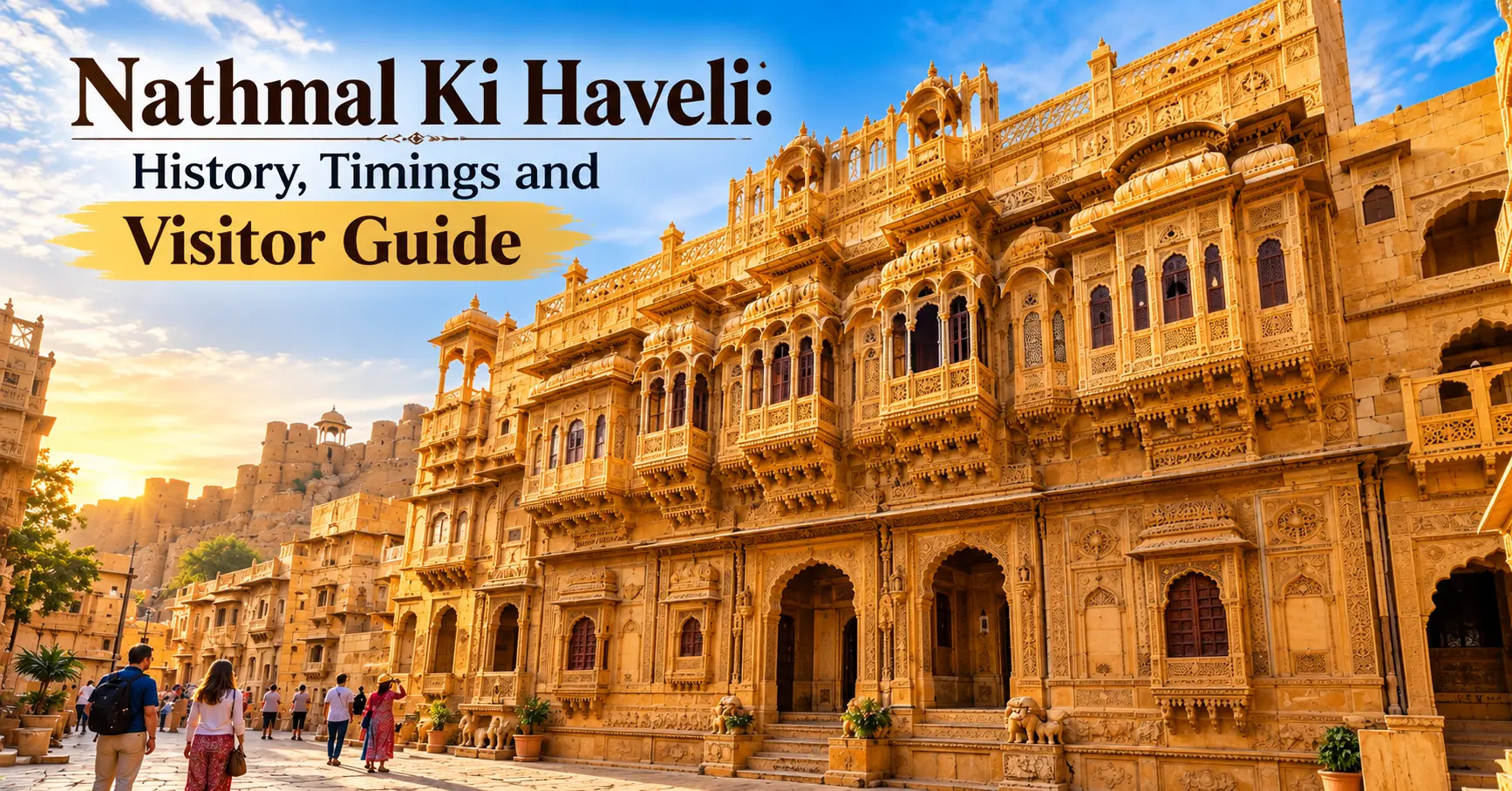
Nathmal Ki Haveli is a 19th-century sandstone mansion in Jaisalmer, Rajasthan, built as a Diwan’s home. Its carved facade and stone elephants draw visitors to the old city.
This guide covers history, architecture, timings, entry details, how to reach the haveli and nearby places. Sources disagree on several facts, so the article flags those clearly.
What You Will Learn
- Who built the haveli and when
- Why the two halves look different
- Reported timings and entry details
- How to reach it from the station and airport
- Which places to pair with your visit
What Is Nathmal Ki Haveli?
Nathmal Ki Haveli, also written Nathmal ji ki haveli, is a historic mansion in central Jaisalmer. It housed Diwan Mohata Nathmal, the kingdom’s prime minister.
Local craftsmen carved it from golden-yellow sandstone, which glows at sunrise and sunset. The facade blends Rajput and Islamic styles, with floral, animal and everyday scenes.
Today, the building is part family home and part shop. Visitors can view the facade and enter areas that remain open to the public.
History of Nathmal Ki Haveli
The haveli belongs to the late 19th century, when Jaisalmer’s court officials and merchants built grand mansions. Its story mixes documented facts with local legend.
Who Built Nathmal Ji Ki Haveli and When?
Incredible India says Maharawal Beri Sal commissioned the haveli in 1885 as the home of Diwan Mohata Nathmal. Other writers give 1895, so treat the exact year as uncertain.
One travel writer notes that Nathmal served as Dewan between 1885 and 1891. That timeline fits a building completed in the late 1880s or early 1890s.
One site claims the haveli took nearly 22 years to finish. Because no second source confirms it, use that figure with caution.
The Legend of the Two Brothers
Local tradition credits two brothers, Hathi and Lulu, with carving the facade. Each brother worked on one half at the same time, without a shared plan.
Seekatour’s guide to places to visit in Jaisalmer repeats this story. Because the brothers carved separately, the two halves resemble each other without matching perfectly.
Some pages wrongly name the builders as Nathmal and Hathi Singh. Nathmal was the Diwan who lived there, not a builder, so that claim looks like an error.
The Haveli Today
The Diwan’s family reportedly still lives in part of the building. Shops also occupy sections, selling souvenirs, textiles and local crafts.
A modern visitor therefore sees a working building, not a quiet museum. Respect private areas, and ask before entering any door that looks closed.
Architecture and Carvings to Look For
The haveli rewards slow viewing. Small details appear as you move along the facade, so allow time to look up, not just ahead.
Sandstone Elephants at the Entrance
Two life-size sandstone elephants stand guard at the front. They are among the most photographed features, especially in soft morning light.
Because the stone is warm and pale, the elephants look their best early or late. Midday sun flattens the carving and adds harsh shadows.
Facade Carvings and Surprising Details
The exterior carries carvings of horses, cattle and flowers. A travel writer also notes unusual scenes, including a steam engine and a bicycle.
These modern touches show how 19th-century artisans reflected the world around them. Look closely at the lower panels and window frames to spot them.
Balconies and Interior Paintings
Ornate jharokhas, or balconies, with lattice screens line the front. They gave families ventilation and a private view of the street.
Inside, ceilings and walls carry carvings and paintings from the 19th century. One writer also mentions framed historical portraits, including King Edward VII.
Why the Two Halves Differ
The two sides mirror each other but vary in small details. According to the legend, the brothers carved their halves without checking each other’s work.
Look for differences in window patterns and decorative bands. Spotting them makes the visit feel like a small treasure hunt.
Nathmal Ki Haveli Timings and Entry Details
Sources disagree on opening hours. Please verify locally on the day of your visit, because private use and shop hours can affect access.
| Source | Reported timings |
| Incredible India | 10:00 AM to 5:00 PM |
| Jaisalmer Tourism | 10:00 AM to 9:00 PM |
| MakeMyTrip | 8:00 AM to 6:00 PM |
Jaisalmer Tourism reports no entry fee. Other pages do not list a fee, so entry appears to be free, though shops inside will charge for purchases.
For safety, plan a daytime visit between 10 AM and 5 PM, which falls within every reported window. That avoids a wasted trip.
Location and How to Reach Nathmal Ki Haveli
The haveli stands in the old city, near Sadar Bazar in central Jaisalmer. You can reach it quickly from the fort area and most hotels in the centre.
| From | Reported distance | Approximate time |
| Jaisalmer Airport | About 6 km | 10 to 15 minutes by taxi |
| Jaisalmer Railway Station | About 4 km | 7 to 10 minutes by taxi |
Jodhpur Airport is another option, but it lies much farther away, so most travelers fly or take trains directly to Jaisalmer.
Autos and taxis cover the short ride. If you stay in the old city, you can walk, though narrow lanes get busy in the afternoon.
Best Time to Visit Nathmal Ki Haveli
October to March is the most comfortable period for sightseeing. November to February is cooler, with highs roughly between 29 and 35°C, according to one weather table.
| Period | What to expect |
| October to March | Pleasant weather, best for walking tours |
| November to February | Coolest days, peak tourist season |
| March to June | Very hot, plan early or late visits |
| July to September | Fewer crowds, but hot and humid at times |
Aim for early morning or late afternoon. The sandstone looks richest at those hours, and the lanes feel calmer, so photos and walking both improve.
Is Nathmal Ki Haveli Worth Visiting?
Yes, if you enjoy architecture, carving and local history. The facade alone justifies a stop, and the haveli sits close to other major sights.
However, expect a small, lived-in building rather than a large museum. Visitors who want grand interiors may prefer Patwon Ki Haveli, which spans five connected mansions.
Nathmal Ki Haveli suits a short, focused visit. Photographers, history lovers and first-time visitors to Jaisalmer will get the most from it.
Nathmal Ki Haveli vs Other Jaisalmer Havelis
Jaisalmer has several famous havelis, and each offers a different experience. This quick comparison helps you decide how to split your time.
| Haveli | Known for | Best for |
| Nathmal Ki Haveli | Elephants, mirrored halves, fine facade carving | A short, photo-friendly stop |
| Patwon Ki Haveli | Five connected merchant mansions | Longer exploration of interiors |
| Salim Singh Ki Haveli | A blue-topped, peacock-themed mansion | Distinctive architecture |
Seekatour’s guide describes all three, though details differ by source. Confirm opening hours for each before you plan a walking route.
How Long Do You Need?
A visit usually takes one to two hours, according to MakeMyTrip. That includes viewing the facade, entering open areas and browsing the shops.
Photographers may want a little extra time for the carvings. Add another hour if you plan to visit the other havelis nearby.
A Simple Half-Day Havelis Route
Start at Nathmal Ki Haveli in the morning, when the light is soft and the lanes are quiet. Spend about an hour on the facade and shops.
Walk or take an auto to Patwon Ki Haveli, then continue to Salim Singh Ki Haveli. Take a tea break in between, because the lanes can feel warm.
Finish at Jaisalmer Fort for lunch or a late-afternoon walk. This order keeps travel short and puts the strongest light on the carvings.
Nearby Places to Combine With Your Visit
Jaisalmer’s havelis sit close to each other, so pairing them makes sense. Plan on a half day for the city-centre stops.
- Patwon Ki Haveli: a cluster of five connected havelis built by merchants.
- Salim Singh Ki Haveli: a mansion known for its peacock-shaped design.
- Jaisalmer Fort: the living fort overlooking the old city.
- Bada Bagh: royal cenotaphs outside town.
- Sam Sand Dunes: a desert stop for sunset, a longer trip.
For the full list of sights, read our guide to places to visit in Jaisalmer. It places each haveli within a wider city plan.
If you travel in winter, check the Jaisalmer Desert Festival dates. The event adds music, crafts and desert events to your trip.
Need a place to stay? See how to reserve a room with zero prepayment before you finalize your Jaisalmer plans.
Photography and Visitor Tips
- Visit early or late for softer light on the carvings.
- Respect residents, and avoid photographing private areas.
- Ask shop owners before taking pictures inside.
- Carry water, especially in summer.
- Wear comfortable shoes for uneven lanes.
I could not verify an official photography rule for the interior. Ask on site, and follow any signs or instructions from residents and shop staff.
Conclusion
Nathmal Ki Haveli rewards a short, careful visit. Its elephants, carvings and mismatched halves tell a story of rivalry and craft that few Jaisalmer sights match.
Verify timings on the day, visit in soft light, and pair it with the other havelis for a full heritage walk.
Frequently Asked Questions
What is Nathmal ki haveli?
Who built Nathmal ji ki haveli?
When was Nathmal ki haveli built?
Is there an entry fee?
What are the timings?
Is the haveli still occupied?
How long does a visit take?
What is near Nathmal ki haveli?