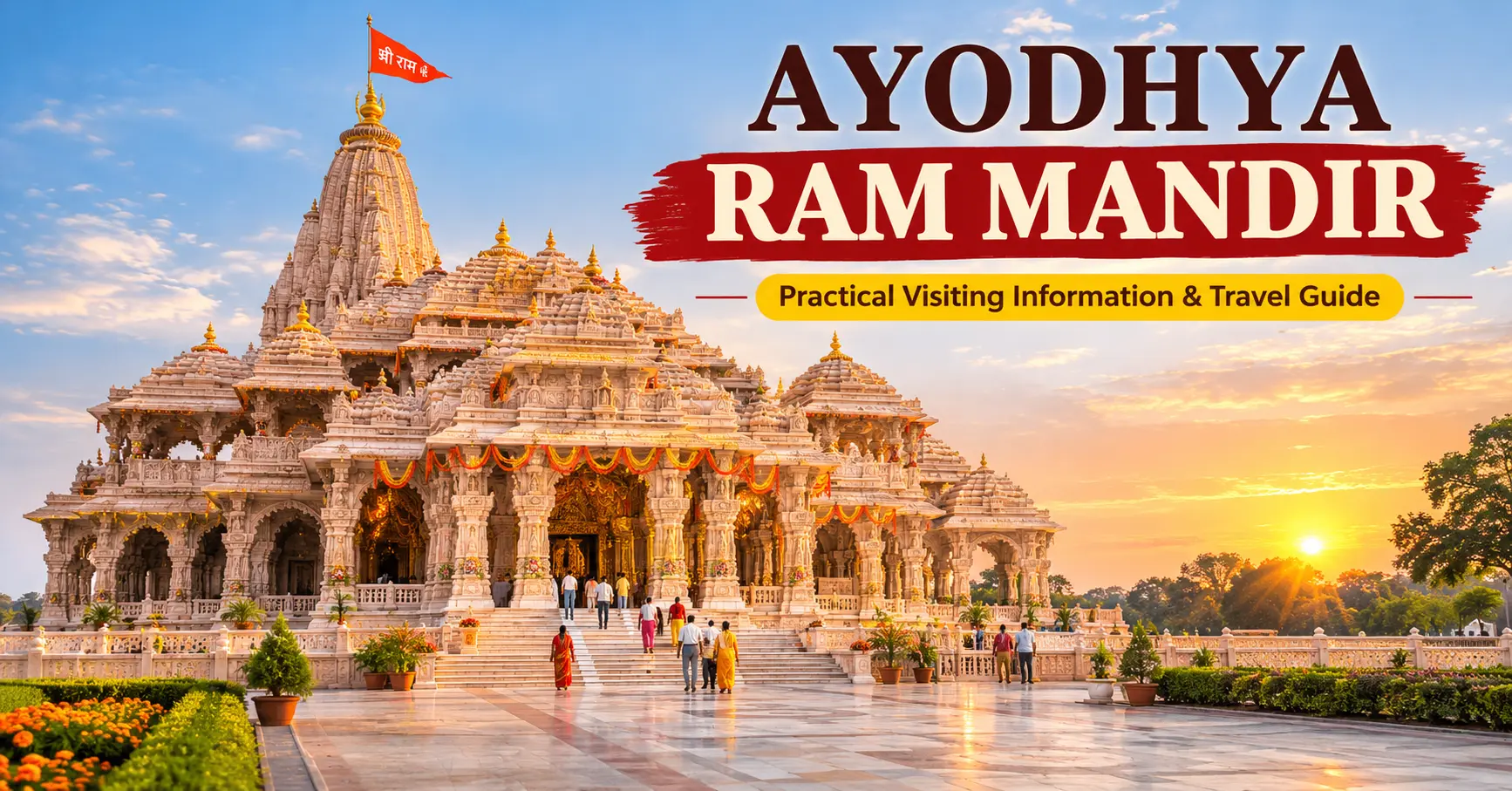
The Ayodhya Ram Mandir is a Hindu temple on the banks of the Saryu river in Uttar Pradesh. Darshan is free, and online slots are available on the official portal.
This guide covers darshan timings, aarti passes, booking steps, entry rules, dress code, transport and the best time to visit. It also separates verified facts from conflicting reports.
However, timings and pass rules changed in 2026, and older pages still circulate. Therefore, confirm every detail on the official Trust portal before you travel.
Key Takeaways
- General darshan is free, and passes are free, according to reported guides.
- The official sites are srjbtkshetra.org and online.srjbtkshetra.org.
- A darshan pass does not give entry to aarti, which needs a separate pass.
- Phones, cameras, smartwatches and large bags are not allowed inside.
- Sources disagree on timings, so check the portal on the day.
- Avoid agents who sell paid VIP tickets.
Ayodhya Ram Mandir at a Glance
Use this table for quick planning. Figures come from travel guides and news reports, so verify them before you book.
| Item | Detail |
| Location | Ayodhya, Uttar Pradesh, on the Saryu river |
| Managed by | Shri Ram Janmabhoomi Teerth Kshetra Trust |
| Consecration | 22 January 2024 |
| Public opening | 23 January 2024 |
| Formal completion | 25 November 2025 (flag hoisting) |
| Entry fee | None reported |
| Booking | Official online portal |
| Pass size | Up to five devotees per pass (single source) |
| Best months | October to March |
What Is the Ayodhya Ram Mandir?
The Ayodhya Ram temple honours Lord Ram. It stands at the site devotees call Ram Janmabhoomi, his birthplace, and the 2019 Supreme Court verdict allowed construction of the temple there.
Pran pratishtha of Ram Lalla took place on 22 January 2024. The temple opened the next day, and about 2.4 million people visited in 12 days, according to Wikipedia.
Construction was formally completed on 25 November 2025, when the Dharma Dhwaja flag was hoisted. Earlier, the Ram Darbar on the first floor was consecrated on 5 June 2025.
Architecture in Brief
The Sompura family of Ahmedabad designed the temple in the Nagara style. Housing.com reports three storeys, 392 pillars and 44 doors, plus a 51-inch black stone idol.
Wikipedia says no iron or steel was used in the construction. The temple covers about 2.7 acres, and the wider complex covers about 70 acres.
Sources give different dimensions for the main structure. Therefore, we avoid quoting a single length or height, and we suggest checking the Trust’s own publications for exact measurements.
Ayodhya Ram Mandir Darshan Timings
Darshan now runs in booked time slots. TemplesTalk, an independent guide updated on 29 September 2026, lists these slots from 18 April 2026.
| Slot | Time |
| 1 | 7:00 am to 9:00 am |
| 2 | 9:00 am to 11:00 am |
| 3 | 11:00 am to 12:00 pm |
| Midday gap | 12:00 pm to 1:00 pm |
| 4 | 1:00 pm to 3:00 pm |
| 5 | 3:00 pm to 5:00 pm |
| 6 | 5:00 pm to 7:00 pm |
| 7 | 7:00 pm to 9:00 pm |
The same guide says no regular public darshan slot runs between 12:00 and 1:00 pm. Walk-in general darshan needs no pass, but booked passes fix your date and time.
Other pages differ. Up Ayodhya lists general darshan from 6:30 am to 12:00 pm and from 2:00 to 10:00 pm.
Housing.com lists 7:00 to 11:30 am and 2:00 to 7:00 pm, but that page dates from 2024. Older timings like these still appear on many sites.
Therefore, treat the slot table as the most recent report, not as an official notice. Check the portal for your date.
Aarti Timings and Passes
Aarti needs a separate pass. A regular darshan pass does not grant aarti entry, according to TemplesTalk, so book the aarti pass in addition to any darshan slot.
| Aarti | Reported time | Source |
| Mangal | 4:00 am | TemplesTalk, Blue Roads |
| Mangal | 4:30 am | Up Ayodhya |
| Shringar | 6:00 am | TemplesTalk, Blue Roads |
| Shringar | 6:30 am | Up Ayodhya |
| Sandhya | 6:00 pm | Blue Roads |
| Sandhya | 7:00 pm | Up Ayodhya |
| Shayan | 10:00 pm | TemplesTalk, Up Ayodhya |
Up Ayodhya says the Mangal, Shringar and Shayan aartis need a free pass from the Trust. It says Bhog and Sandhya aartis are open darshan.
Blue Roads gives different times for Sandhya and Shayan. Therefore, confirm the exact time when you book your pass, because the portal shows the slot for your date.
Timings can shift on Ekadashi, Purnima and festival days, according to Up Ayodhya. Also expect fewer passes on those dates.
How to Book Darshan and Aarti Passes
Book only through the official channels. TemplesTalk, Blue Roads and Up Ayodhya name the Trust site, srjbtkshetra.org, and the booking portal, online.srjbtkshetra.org.
Booking Steps
Follow these steps, which combine guidance from several guides. Each step appears in at least one source, so check the portal for any change.
- Open the official booking portal.
- Register or log in with your mobile number and OTP.
- Choose General Darshan, Sugam Darshan or Aarti.
- Select a date and a time slot.
- Enter details for every devotee, up to five per pass.
- Check the details, confirm and save the pass.
- Carry a printed or offline copy, plus the same photo ID.
Pass Rules to Know
Passes are free but limited, according to Blue Roads and TemplesTalk. One pass covers up to five devotees, and TemplesTalk says it was eight earlier.
Up Ayodhya says aarti booking closes 24 hours before the aarti. Blue Roads says you should confirm attendance online about 24 hours before, or the pass may be re-allotted.
Blue Roads adds that children under 10 need no separate pass if an adult with a valid pass accompanies them. These are single-source rules, so confirm them.
Beware of Paid VIP Tickets
TemplesTalk warns against paid VIP tickets sold by agents or third-party sites. Therefore, book yourself on the official portal, and ignore offers that promise faster entry.
Never pay a middleman for a darshan or aarti pass. Also avoid sharing your ID details on unofficial websites, because that exposes your personal data.
Entry Rules, Dress Code and What to Carry
Security is strict. TemplesTalk lists restricted items, including mobile phones, cameras, smartwatches, power banks, large bags and sharp objects, so pack light before you leave.
Housing.com lists phones, footwear, purses, flowers, garlands and prasad as prohibited. The lists differ, so ask the Trust or security staff before you enter.
Free cloakroom and locker facilities are available outside the restricted area, according to TemplesTalk. Therefore, carry only your ID, your pass and minimal cash.
Dress Code
Wear clean, modest clothing. For example, men can wear a kurta-pyjama, dhoti-kurta or trousers with a shirt.
Women can wear a saree, salwar-kameez or a kurta with full-length bottoms. Avoid very short or revealing clothes, and choose footwear that is easy to remove.
Documents
Carry an original government photo ID, such as Aadhaar, a passport or a voter ID. The name on the booking must match the ID.
Foreign visitors should carry a passport. Meanwhile, Blue Roads says a driving licence is also accepted, but confirm this on the portal.
How to Reach Ayodhya
Ayodhya sits in eastern Uttar Pradesh and connects well by rail, air and road. The last stretch to the temple can be restricted, so plan for a short walk.
| Mode | Details |
| Train | Ayodhya Dham Junction or Ayodhya Cantt |
| Air | Maharishi Valmiki International Airport Ayodhyadham |
| Road | Links to Lucknow, Prayagraj, Varanasi and Gorakhpur |
| Last mile | E-rickshaw, auto, taxi or walking where vehicles are restricted |
Housing.com puts the airport about 8 to 10 km from the city centre. It puts the main railway station about 6 to 8 km away.
Rail distances to Ayodhya, according to Housing.com, are 636 km from Delhi, 128 km from Lucknow, 171 km from Gorakhpur, 157 km from Prayagraj and 196 km from Varanasi.
Vehicle access near the temple may be restricted, according to TemplesTalk. Therefore, allow extra time and avoid last-minute arrivals, especially on weekends and festival days.
If you plan a longer pilgrimage, read our guide to the Maha Kumbh Mela in Prayagraj. Prayagraj is about 157 km from Ayodhya by rail.
Best Time to Visit Ayodhya
October to March is the most comfortable period, according to Housing.com. Cooler weather also makes queues easier to manage, especially in the early morning slots.
| Period | What to expect |
| October to March | Cooler weather, peak visitor season |
| April to June | Hot days, plan early or late slots |
| July to September | Monsoon rain, humid conditions |
| Festival dates | Heavier crowds, changed routes, fewer passes |
Ram Navami, Deepotsav and Kartik Purnima bring heavier crowds and stricter security, according to TemplesTalk. Therefore, book early if you plan to visit then.
Our advice: choose a weekday and an early slot. Queues build through the day, and a calm start leaves time for rest and meals.
How Much Time to Plan
Our advice: plan at least half a day for the temple. Security checks, cloakroom time and queues all add to the time you spend inside the complex.
Allow a full day if you also want to walk by the Saryu river or visit other sites. We did not verify other Ayodhya timings, so check locally.
For overnight stays, book hotels early around festivals, because rooms fill quickly. Meanwhile, pilgrims from Lucknow or Varanasi can plan a long day trip, but the road adds travel time.
Tips for a Smooth Visit
A few habits prevent most problems. These tips combine our research and the guides we reviewed, and they apply to every slot and every season.
- Arrive 30 to 60 minutes before your slot.
- Agree on a family meeting point before you deposit phones.
- Keep your pass and ID together.
- Wear comfortable clothes and easy footwear.
- Carry little, because lockers and queues take time.
- Check the portal again on the morning of your visit.
For wider temple trips, our guide to the Char Dham Yatra helps you plan a longer pilgrimage. Combine it with this guide when you build a multi-stop itinerary.
Details We Could Not Verify
Several sources disagree, and we could not open the official portal. The table below shows what to check before you travel.
| Item | What sources say | Action |
| Darshan hours | Slots 7 am to 9 pm (TemplesTalk), other hours (Up Ayodhya, Housing.com) | Check the portal |
| Mangal Aarti | 4:00 am, 4:00 to 5:00 am, 4:30 am | Confirm on booking |
| Sandhya Aarti | 6:00 pm (Blue Roads), 7:00 pm (Up Ayodhya) | Confirm on booking |
| Shayan Aarti | 10:00 pm, 8:00 to 10:00 pm (Blue Roads) | Confirm on booking |
| Pass size | Up to five (TemplesTalk) | Single source |
| Pass deadline | 24 hours before (Up Ayodhya, Blue Roads) | Confirm on booking |
| Prohibited items | Two different lists (TemplesTalk, Housing.com) | Ask the Trust |
| Child pass | Under 10 free of pass (Blue Roads) | Single source |
| Airport distance | 8 to 10 km (Housing.com) | Verify on a map |
| Temple dimensions | Several different figures | Avoid a single figure |
Final Thoughts
The Ayodhya Ram Mandir is easy to visit if you book through the official portal and plan around the 2026 slot system. Start with the portal, not with an agent.
Before you go, confirm timings, pass rules and restricted items on the day of your visit. Moreover, avoid paid VIP offers, and keep your ID and booking copy ready.