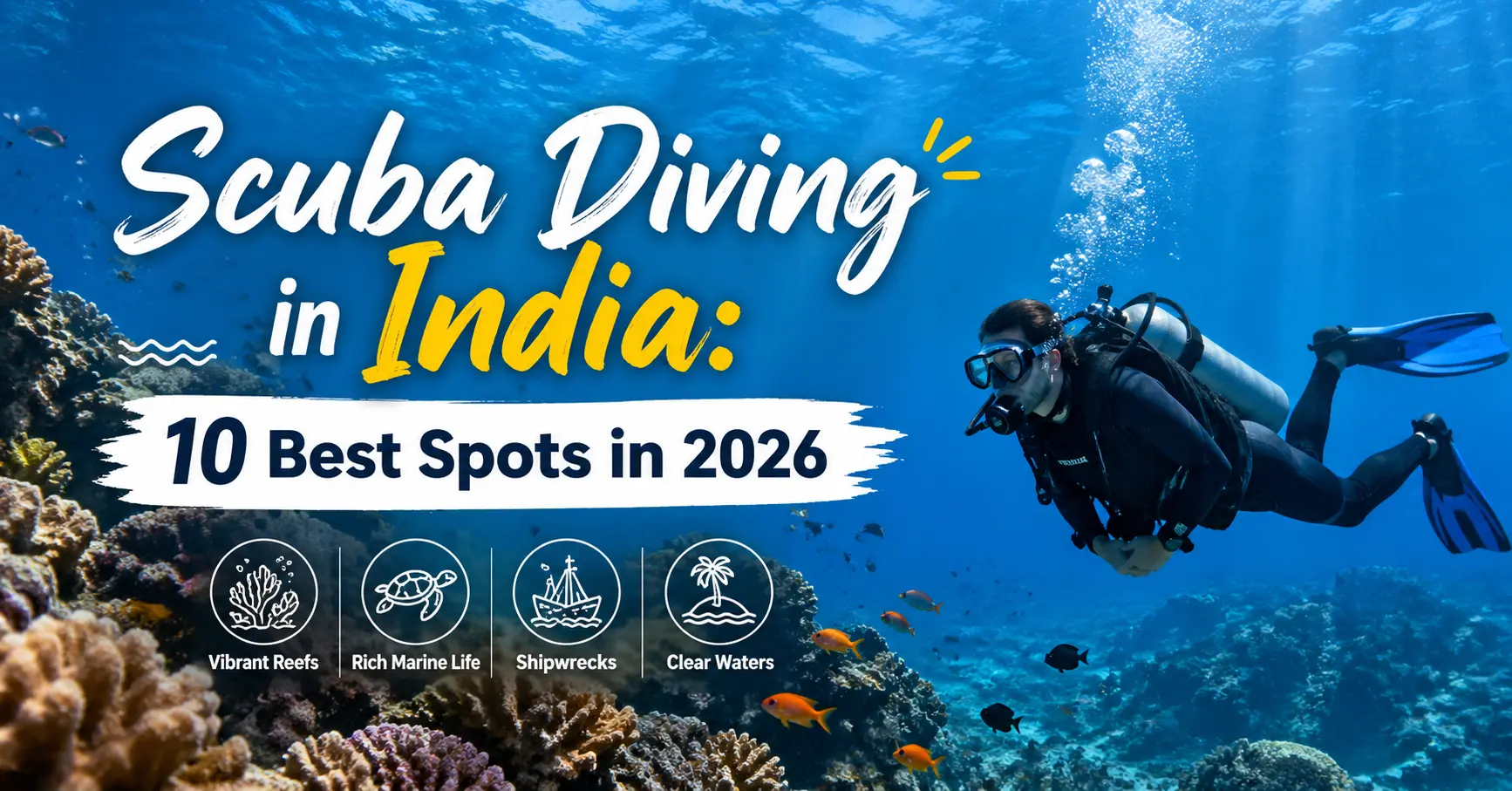
Scuba diving in India is one of the most underrated underwater adventures on earth. With over 7,500 kilometres of coastline spanning the Arabian Sea, the Bay of Bengal, and the Indian Ocean, India offers a diving experience that rivals destinations like Thailand and the Maldives at a fraction of the cost.
Furthermore, most travelers have no idea that world-class coral reefs, historic shipwrecks, and rare marine life sit just beneath India’s surface. This guide covers all ten of the best scuba diving destinations across the country so you can choose the right spot for your skill level, budget, and travel style.
What You Will Learn
- The 10 best destinations for scuba diving in India from coast to island
- What marine life, dive sites, and visibility each destination offers
- Costs, best seasons, and difficulty levels for every location
- Beginner-friendly vs advanced diving spots across India
- Practical tips for first-time and certified divers planning an India dive trip
- How to choose the right destination based on budget, skill level, and travel style
Why India Is a World-Class Scuba Diving Destination
India’s underwater world is extraordinary in its diversity. Over 7,500 kilometres of coastline span three major water bodies, each offering a completely different diving environment and marine ecosystem.
Furthermore, the Andaman and Nicobar Islands and Lakshadweep add two premium island dive territories that consistently rank among the best in Asia. Most notably, marine life ranges from whale sharks and manta rays to nudibranchs, sea turtles, and schooling barracuda depending on where you dive.
Dive sites exist for absolute beginners through to advanced technical divers across every region. As a result, scuba diving in India delivers genuine world-class experiences at costs significantly lower than comparable international destinations, making it one of the best-value dive destinations on earth.
1. Scuba Diving in Goa: Wrecks, Reefs, and Warm Arabian Sea Waters
Scuba diving in Goa is the most accessible and popular entry point into India’s underwater world. Grand Island serves as the primary dive hub, offering coral gardens, reef fish, and whale shark sightings during season.
Furthermore, the Portuguese shipwrecks lying on the seabed off the Goa coast give it a unique character that few other Indian dive destinations can match. Most notably, the River Princess wreck is one of the most famous and photographed dive sites anywhere in India.
Top Dive Sites in Goa
Grand Island delivers coral reefs and abundant reef fish suitable for all experience levels. Suzy’s Wreck and Bounty Bay serve intermediate and advanced divers looking for more technical underwater experiences.
In particular, the River Princess remains the signature experience for any diver visiting Goa. Moreover, whale shark sightings off Grand Island during the October to May season add a genuinely thrilling dimension to diving in this region.
Practical Information for Goa Diving
- Best season: October to May for best visibility and calm Arabian Sea conditions
- Average cost: INR 2,500 to 5,000 per dive for beginners
- Difficulty level: Beginner to intermediate across most sites
- Water temperature: 27 to 30 degrees Celsius year-round
💡 Tip: Book your Goa dive in the early morning. Afternoon winds can reduce visibility and create choppy conditions on the water surface.
2. Netrani Island Scuba Diving: Karnataka’s Crown Jewel
Netrani island scuba diving is widely considered the finest marine diving experience on India’s western mainland coast. This heart-shaped uninhabited island sits 20 kilometres off the Murudeshwar coast and is a protected marine sanctuary.
Furthermore, the coral reef health and water clarity around Netrani consistently surpass those of many better-known Indian dive destinations. As a result, divers who make the effort to reach Netrani consistently rate it as one of the best underwater experiences of their lives.
What Makes Netrani Island Unique
Whale sharks, barracuda schools, manta rays, and sea turtles are all regularly encountered at Netrani. Most notably, it is one of the few places in India where pelagic open-water species and vibrant reef species can be seen on the same dive.
Beyond that, the sheer density of marine life at Netrani is what separates it from most Indian dive destinations. In particular, the hard coral formations here are among the healthiest on the entire western coastline.
Practical Information for Netrani Island Diving
- Best season: September to May for optimal visibility and calm sea conditions
- Average cost: INR 3,500 to 6,000 per dive including boat transfer
- Difficulty level: Intermediate to advanced due to currents and open water exposure
- Access: Accessible from Murudeshwar by boat in approximately 45 minutes
3. Scuba Diving in Murudeshwar: Gateway to Karnataka’s Best Dive Waters
Scuba diving in Murudeshwar offers the most practical mainland base for exploring the Karnataka coastline’s dive sites. The town combines religious tourism with growing adventure diving infrastructure in a way that makes it genuinely unique on India’s west coast.
Moreover, Murudeshwar is the primary departure point for Netrani Island day trips, making it central to any serious scuba diving in Karnataka itinerary. Additionally, shore dives along the Murudeshwar coastline itself provide accessible beginner experiences without needing a boat transfer.
Top Dive Sites Around Murudeshwar
Rocky reef structures along the Karnataka shoreline offer rich coral growth and resident reef fish populations. Shore dives directly off the Murudeshwar coastline suit beginner and intro-dive experiences perfectly.
Furthermore, Netrani Island remains the premium day-trip dive destination that makes Murudeshwar worth including in any west coast India dive itinerary. In addition, the combination of accessible shore dives and premium offshore diving gives Murudeshwar an unusually wide appeal across all diver experience levels.
Practical Information for Murudeshwar Diving
- Best season: October to April for calm Arabian Sea conditions
- Average cost: INR 2,500 to 4,500 per dive for shore sites
- Difficulty level: Beginner for shore dives, intermediate to advanced for Netrani trips
- Ideal for: Combining with a Karnataka coastal road trip itinerary
4. Scuba Diving in Gokarna: Hidden Reefs on the Karnataka Coast
Scuba diving in Gokarna is the choice for travelers who want quiet waters, uncrowded sites, and a genuinely off-the-beaten-path coastal experience. Unlike Goa, Gokarna remains relatively undiscovered by mass tourism, which benefits its dive sites significantly.
Furthermore, scuba diving in Karnataka through Gokarna gives access to rocky reef formations, underwater cave systems, and a diverse resident marine life population that rewards patient and experienced divers. Most notably, the uncrowded nature of Gokarna’s dive sites means better wildlife encounters and more relaxed diving conditions overall.
Top Dive Sites Around Gokarna
Rocky reef and boulder formations off the Gokarna coastline support a healthy population of moray eels, octopus, reef fish, and leopard sharks. Underwater cave systems are accessible to experienced divers with proper certification and guided dives.
Beyond that, the combination of cave diving, reef diving, and genuinely clear water during peak season makes Gokarna an increasingly popular choice among repeat India divers. In addition, its proximity to Murudeshwar and Netrani Island makes it easy to combine multiple Karnataka dive experiences in a single trip.
Practical Information for Gokarna Diving
- Best season: November to March for clearest visibility and calmest conditions
- Average cost: INR 2,500 to 4,000 per dive
- Difficulty level: Beginner to intermediate across accessible sites
- Best combined with: Murudeshwar and Netrani for a full Karnataka dive itinerary
5. Scuba Diving in Pondicherry: Southeast India’s Best Reef Diving
Scuba diving in Pondicherry is the undisputed highlight of scuba diving on India’s east coast. Temple Reef, the largest artificial reef in South Asia, has become one of the most biodiverse dive sites in the entire country.
In particular, over 100 species have been recorded at a single dive on Temple Reef, which is a figure that rivals many internationally celebrated reef destinations. Furthermore, whale shark encounters are possible from May through August, adding a genuinely spectacular dimension to Pondicherry diving.
Top Dive Sites in Pondicherry
Temple Reef dominates the Pondicherry diving scene with its extraordinary marine biodiversity and year-round dive conditions. Rocky reef systems supporting nudibranchs, moray eels, sea snakes, lobsters, and soft coral formations provide excellent macro photography opportunities.
Most notably, the combination of an accessible French colonial town and world-class reef diving makes Pondicherry one of the most complete dive travel destinations in India. Moreover, the east coast location means it enjoys different seasonal conditions from west coast destinations, extending the national dive calendar for traveling divers.
Practical Information for Pondicherry Diving
- Best season: January to April for best visibility on the east coast
- Average cost: INR 2,500 to 5,000 per dive depending on certification level
- Difficulty level: Beginner to advanced with sites suitable for all experience levels
- Key operator: Temple Adventures is the primary PADI-certified operator in Pondicherry
Read Also: Skydiving in India: Best Locations, Cost, and Safety
6. Scuba Diving in Neil Island: Andaman’s Quieter Gem
Scuba diving in Neil Island offers a more intimate and unhurried alternative to the busier Havelock Island experience within the Andaman archipelago. The pristine coral gardens and exceptional water clarity here consistently attract divers who want quality over crowds.
Furthermore, Neil Island’s smaller dive operator community means more personalized attention and smaller group sizes compared to the larger Havelock operations. As a result, many experienced divers rate Neil Island as their preferred Andaman dive base despite Havelock’s greater fame.
Top Dive Sites Around Neil Island
K Rock and Margherita’s Mischief are the two signature dive sites that define the Neil Island underwater experience. Pristine hard coral formations with visibility reaching up to 30 metres characterize both sites during peak season.
Moreover, marine life including reef sharks, sea turtles, Napoleon wrasse, and dense reef fish populations make every dive at Neil Island genuinely memorable. In particular, the seamounts accessible from Neil Island attract experienced divers seeking challenging current dives with pelagic species encounters.
Practical Information for Neil Island Diving
- Best season: November to April for optimal Andaman diving conditions
- Average cost: INR 3,500 to 6,500 per dive including all equipment
- Difficulty level: Beginner to advanced with sites across all experience levels
- Access: Accessible by ferry from Port Blair in approximately two hours
7. Scuba Diving in Chennai: Urban Diving on the Coromandel Coast
Scuba diving in Chennai is the most practical option for city-based travelers across South India who want to experience scuba diving without committing to a long-haul island trip. The Coromandel Coast off Chennai provides accessible dive sites with genuine marine biodiversity.
Furthermore, a growing network of certified dive operators serving Chennai-based divers has made this an increasingly credible first-dive destination for Tamil Nadu residents. That said, experienced divers should view Chennai primarily as a try-dive or certification location rather than a bucket-list dive destination.
Top Dive Sites Around Chennai
Kovalam Beach and Mahabalipuram serve as the primary coastal dive access points for Chennai-based operators. Artificial reef structures and rocky outcrops along this stretch of coast support groupers, barracuda, sea snakes, and soft coral formations.
In particular, the accessibility of these sites from Chennai city makes them ideal for quick day-trip dive experiences. Additionally, some operators offer introductory pool sessions in Chennai itself before taking beginners to the coastal dive sites.
Practical Information for Chennai Diving
- Best season: February to April for clearest Bay of Bengal visibility
- Average cost: INR 2,000 to 4,000 per dive for beginner intro experiences
- Difficulty level: Beginner to intermediate across accessible coastal sites
- Ideal for: First-time divers before committing to an Andaman or Pondicherry dive trip
8. Scuba Diving in Dwarka: Gujarat’s Hidden Underwater Heritage
Scuba diving in Dwarka is unlike any other dive experience in India. Underwater ruins of the ancient city of Dwarka discovered off the Gujarat coastline give this destination a historical dimension that no other Indian dive site can match.
Most notably, archaeological dive sites exist alongside natural reef and rock formations, creating an experience that combines marine adventure with ancient history on a single dive. Furthermore, the combination of history and underwater exploration makes Dwarka increasingly popular among divers who have already experienced the traditional Indian dive destinations.
What Makes Dwarka Diving Unique
The submerged ruins of ancient Dwarka represent one of the most significant underwater archaeological sites in Asia. Marine life typical of the northern Arabian Sea, including rays, groupers, and reef fish, inhabits the structures alongside the historical remains.
In particular, guided archaeological dives offer context and interpretation that transforms the experience from simple reef diving into something genuinely educational. Additionally, Dwarka’s location in Gujarat makes it highly accessible for divers based in Ahmedabad, Surat, or Mumbai seeking a weekend dive without flying.
Practical Information for Dwarka Diving
- Best season: October to March for calmest Arabian Sea conditions in this region
- Average cost: INR 2,000 to 4,500 per dive including guide and equipment
- Difficulty level: Beginner to intermediate for reef sites, intermediate for archaeological dives
- Unique factor: The only dive destination in India combining active archaeology and marine diving
9. Scuba Diving in Alibaug: Mumbai’s Closest Dive Getaway
Scuba diving in Alibaug is the most practical scuba diving option for the millions of travelers based in or visiting Mumbai. A short ferry ride from the Gateway of India makes Alibaug one of the most accessible dive day-trip destinations anywhere in India.
Furthermore, the growing number of certified dive operators in Alibaug has significantly improved the quality and safety of the diving experience available here. As a result, Alibaug has become the preferred first-dive destination for curious Mumbai residents before they commit to longer trips to Goa or the Andamans.
Top Dive Sites Around Alibaug
Khanderi Island and Underi Island serve as the primary offshore dive sites for Alibaug-based operators. Rocky reef structures along the Konkan coastline support sea stars, soft corals, reef fish, and occasional ray sightings.
In particular, the sheltered waters around Khanderi Island make it ideal for beginner divers experiencing the underwater world for the first time. Additionally, the historic Khanderi Fort above the waterline adds a sightseeing dimension to the Alibaug dive day trip experience.
Practical Information for Alibaug Diving
- Best season: November to February for best visibility in Konkan waters
- Average cost: INR 2,000 to 4,000 per dive for beginner experiences
- Difficulty level: Beginner to intermediate, ideal for first-time divers
- Access: Ferry from Mumbai Gateway of India in under two hours
Read Also: Jim Corbett National Park: India’s First Wildlife Sanctuary
10. The Andaman and Nicobar Islands: India’s Premier Scuba Diving Destination
The Andaman Islands represent the absolute pinnacle of scuba diving in India for serious divers. Clear warm water, extraordinary marine biodiversity, and world-class dive sites consistently place the Andamans among the top ten dive destinations in all of Asia.
Furthermore, international dive publications regularly compare the Andamans favorably with the Maldives and Thailand in terms of reef quality and marine life density. Most notably, the cost of diving here is dramatically lower than those internationally celebrated destinations, making the Andamans one of the best-value premium dive experiences on earth.
Top Dive Sites in the Andamans
Dixon’s Pinnacle is the Andamans’ signature dive, featuring giant underwater mounds covered in fluorescent soft corals with resident manta rays. Barracuda City delivers schooling barracuda in numbers unmatched at any other dive site in India.
Moreover, Johnny’s Gorge and the Wall at Havelock Island are signature deep dives for experienced and advanced-certified divers. In addition, Neil Island’s seamounts offer quiet and pristine reef diving away from the larger Havelock operations.
Marine Life Highlights
Manta rays, whale sharks, reef sharks, sea turtles, Napoleon wrasse, and batfish are all regularly encountered across Andaman dive sites. Furthermore, over 100 species have been recorded at single sites during peak visibility months from November through April.
Most notably, Dixon’s Pinnacle has been described by professional dive instructors as one of the most breathtaking dive sites they have ever experienced. As a result, the Andamans should sit at the top of every serious diver’s India itinerary without exception.
Practical Information for Andaman Diving
- Best season: November to April for optimal visibility and calm sea conditions
- Average cost: INR 3,500 to 8,000 per dive depending on operator and site
- Difficulty level: All levels with sites from beginner reef dives to advanced technical dives
- Access: Fly from mainland India to Port Blair then take ferry to Havelock or Neil Island
Scuba Diving in India: Cost Comparison Across All Destinations
| Destination | Beginner Cost | Certified Diver Cost | Best Season |
| Scuba diving in Goa | INR 2,500 to 4,000 | INR 3,000 to 5,000 | Oct to May |
| Scuba diving in Pondicherry | INR 2,500 to 4,500 | INR 3,000 to 5,000 | Jan to Apr |
| Scuba diving in Murudeshwar | INR 2,500 to 4,000 | INR 3,000 to 5,000 | Oct to Apr |
| Netrani island scuba diving | INR 3,500 to 5,500 | INR 4,000 to 6,000 | Sep to May |
| Scuba diving in Gokarna | INR 2,500 to 3,500 | INR 3,000 to 4,500 | Nov to Mar |
| Scuba diving in Dwarka | INR 2,000 to 3,500 | INR 2,500 to 4,500 | Oct to Mar |
| Scuba diving in Chennai | INR 2,000 to 3,500 | INR 2,500 to 4,000 | Feb to Apr |
| Scuba diving in Neil Island | INR 3,500 to 5,500 | INR 4,000 to 6,500 | Nov to Apr |
| Scuba diving in Alibaug | INR 2,000 to 3,500 | INR 2,500 to 4,000 | Nov to Feb |
| Andaman Islands | INR 4,000 to 6,000 | INR 5,000 to 8,000 | Nov to Apr |
Furthermore, equipment rental is typically included in the costs listed above for beginner experiences. Most notably, certified divers who bring their own equipment receive discounts ranging from INR 500 to 1,500 per dive at most Indian operators.
Beginner vs Certified Diver: Which Destinations Suit You Best?
Choosing the right destination for your experience level is the single most important planning decision when it comes to scuba diving in India. The wrong destination for your skill level reduces both safety and enjoyment significantly.
Furthermore, India’s ten best dive destinations span the full spectrum from completely beginner-friendly to genuinely advanced, which means every type of diver has the perfect option available.
Best Destinations for Beginner and First-Time Divers
Scuba diving in Goa offers the most developed beginner infrastructure in India, with gentle conditions and experienced intro-dive operators. Scuba diving in Alibaug provides the simplest access from Mumbai for first-time try-dive experiences close to home.
For instance, scuba diving in Murudeshwar offers calm shore dives that build initial water confidence before attempting the more demanding Netrani Island trip. In particular, scuba diving in Chennai suits curious first-timers who want to try the experience before committing to a longer travel itinerary.
Best Destinations for Intermediate and Advanced Certified Divers
Netrani island scuba diving requires intermediate experience due to open water currents and pelagic encounter conditions. Scuba diving in Neil Island seamounts with strong currents specifically suit advanced-certified divers seeking challenging and rewarding dives.
Similarly, Dixon’s Pinnacle and Johnny’s Gorge in the Andaman Islands are advanced-level signature dives that require good buoyancy control and current-diving experience. Most notably, scuba diving in Dwarka archaeological sites require excellent buoyancy and navigation skills to explore the submerged ruins safely.
Practical Tips Before You Go Scuba Diving in India
Best Time of Year for Scuba Diving in India
West coast destinations including Goa, Murudeshwar, Gokarna, and Alibaug are best visited between October and May. East coast destinations including Pondicherry and Chennai offer best conditions from January through April.
Furthermore, Andaman Islands including Neil Island are best dived between November and April for optimal visibility. In particular, September through May offers good conditions across Lakshadweep when the lagoon waters are calm and clear.
What Certification Do You Need
Beginner try-dives require no certification and are fully supervised throughout the experience. PADI Open Water or SSI Open Water certification is required for independent certified dives at any Indian dive site.
Moreover, Advanced Open Water certification is strongly recommended for Netrani Island, Dixon’s Pinnacle, and the deeper Andaman sites. As a result, non-certified travelers planning multiple dives should consider completing their Open Water course before arriving in India to maximise the dive sites accessible to them.
What to Bring on Your India Dive Trip
Swimwear, a rash guard, reef-safe sunscreen, and any personal medications are the essential personal items for any India dive trip. Dive certification cards and logbooks should be carried by all certified divers for verification by operators.
Furthermore, an underwater camera or GoPro housing significantly enhances the value of the dive experience at marine-rich sites like Netrani Island and the Andamans. That said, most operators offer GoPro rental for guests who do not own underwater photography equipment.
Safety Tips for Scuba Diving in India
Always book exclusively with PADI or SSI certified operators regardless of the destination or the price difference. Check operator equipment condition and servicing records before booking any dive, particularly at smaller operators in less-visited destinations.
Above all, never dive beyond your certification depth limit regardless of what a guide suggests during the dive. Consequently, staying well-hydrated, avoiding alcohol before diving, and always completing a full buddy check before entry are the non-negotiable safety habits for every dive in India.
💡 Tip: Always ask to see your dive operator’s certification and equipment service records before booking. A reputable operator will provide these without hesitation.
Conclusion
Scuba diving in India offers extraordinary underwater experiences across ten completely different destinations, each with its own marine character, seasonal conditions, and appeal for different types of divers. From the beginner-friendly waters of Goa and Alibaug to the world-class reefs of Netrani Island and the Andamans, India has a dive destination that fits every skill level and every budget.
Furthermore, the combination of historical intrigue at Dwarka, reef biodiversity at Pondicherry, and island grandeur across the Andamans makes India one of the most diverse dive countries in the entire world. Most notably, all of this is available at costs that make comparable international destinations look overpriced by comparison.
Choose your destination based on your experience level, your travel base, and the marine encounters you want most. In fact, the only question left to answer is which Indian dive destination you explore first.
Frequently Asked Questions
What is the best place for scuba diving in India?
Is scuba diving in Goa good for beginners?
What is the cost of scuba diving in India?
Is netrani island scuba diving suitable for non-swimmers?
What is the best season for scuba diving in India?
How is scuba diving in Pondicherry compared to Goa?
Can you see whale sharks while scuba diving in India?
Is scuba diving in Murudeshwar and Gokarna worth it?
What marine life can you see while scuba diving in Neil Island?
Is scuba diving in Alibaug good for Mumbai travelers?