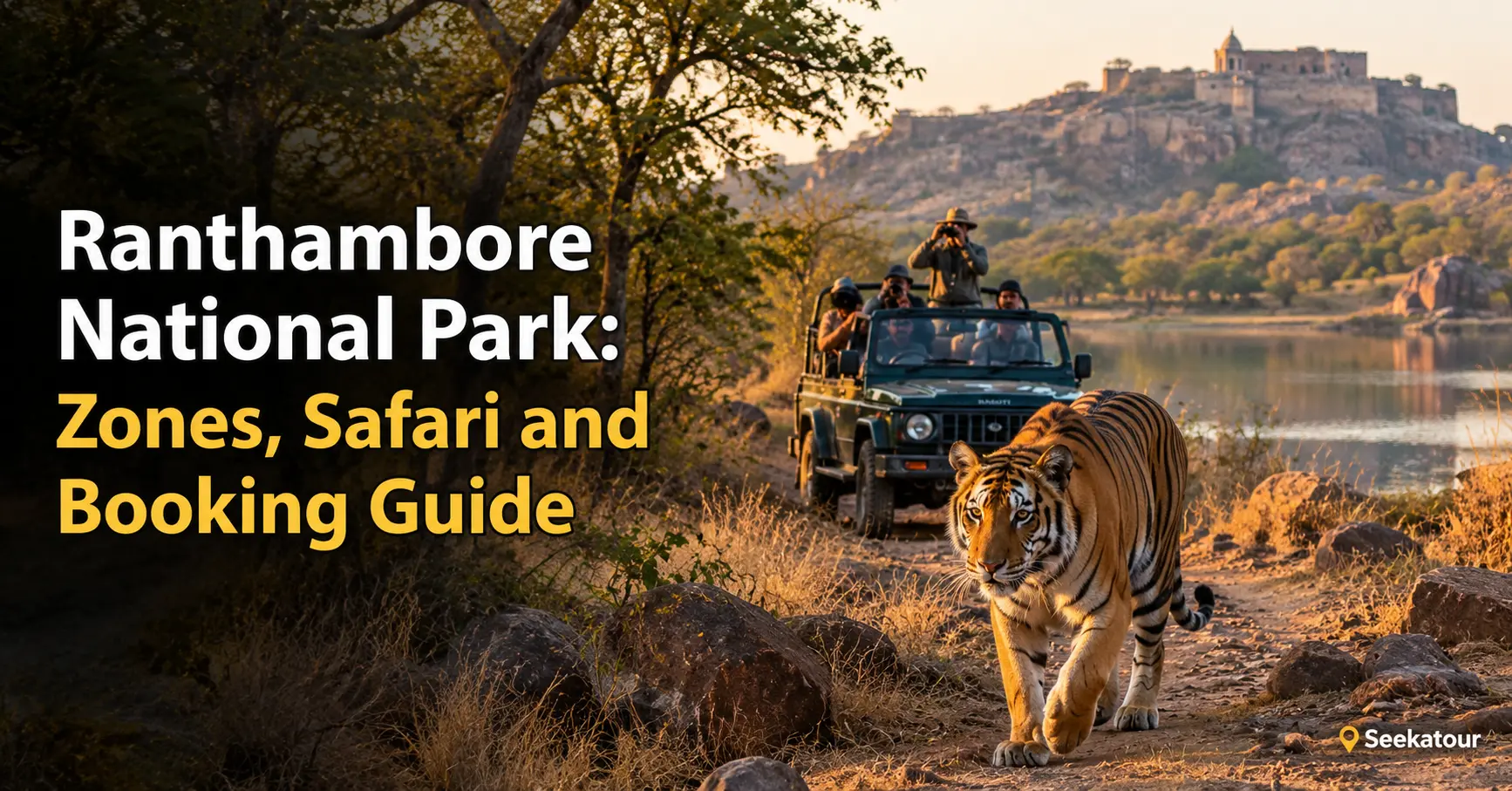
Rajasthan’s most iconic tiger reserve blends dense forest, rocky hills, and a 10th-century fort into one landscape. Furthermore, Ranthambore National Park ranks among India’s most reliable places to spot a wild Bengal tiger.
Most notably, choosing the right zone and booking early genuinely shapes your entire safari experience. This guide covers zones, vehicles, timings, fees, and honest booking advice for 2026.
What You Will Learn
- What Ranthambore National Park is and its Project Tiger history
- Ranthambore National Park zones and which ones suit tiger sightings
- Ranthambore National Park safari types, Gypsy versus Canter
- Ranthambore National Park timings and seasonal closure dates
- Ranthambore National Park entry fees and honest pricing guidance
- Ranthambore National Park booking process, including Tatkal quota
What Is Ranthambore National Park?
Once the private hunting grounds of the Maharajas of Jaipur, this reserve became a wildlife sanctuary in 1955. Most notably, the park joined Project Tiger in 1973, cementing its role in India’s tiger conservation efforts.
Today, Ranthambore National Park spans roughly 1,334 sq km, including its core zone and surrounding buffer areas. As a result, the reserve now functions as one connected ecosystem rather than a single fenced-off forest block.
It’s worth noting that some sources cite the park’s core critical tiger habitat separately, at approximately 282.03 sq km. Furthermore, this smaller figure represents only the strictly protected core, while the larger number includes buffer forest.
Ranthambore National Park Zones
The park divides into 10 safari zones, with Zones 1 to 5 forming the original core protected forest. Most notably, these core zones traditionally carry higher tiger density due to denser vegetation and established territories.
Zones 6 to 10 form buffer areas added later, though many visitors report genuine tiger sightings here too. As a result, tiger movement remains unpredictable, so no single zone guarantees a sighting on any given day.
Each zone offers a distinct landscape, from open grassland to rocky ravines and lake-adjacent forest. Furthermore, this variety means every zone rewards visitors with different wildlife, even without a tiger appearing.
Best Zones for Tiger Sightings
Zone allocation depends on availability and forest department regulations, so requesting a preference does not guarantee it. Most notably, Zones 2, 3, and 4 consistently rank among the most recommended for serious tiger trackers.
As a result, booking these zones early becomes especially important during peak tourist months. Furthermore, popular zones fill quickly once October bookings open for the upcoming season.
Ranthambore National Park Safari: Gypsy vs Canter
The Gypsy safari accommodates up to six passengers, offering flexibility that suits wildlife photographers and serious trackers. Most notably, the Canter safari carries a larger group but struggles to reach smaller tracks where sightings often happen.
As a result, choosing between the two depends on your priorities: intimacy and flexibility, or group size and cost. Furthermore, both vehicles follow the same permitted routes and safari timings within each zone.
Vehicle Comparison Table
| Vehicle | Capacity | Best For | Approximate Price (Indian nationals) |
| Gypsy (Jeep) | 6 passengers | Photographers, serious trackers | ₹1,900 plus per person |
| Canter | Larger groups | Budget travelers, families | ₹1,300 plus per person |
Most notably, Gypsy safaris cost more per person but offer better maneuverability on narrow forest tracks. As a result, photographers and dedicated tiger trackers usually favor the Gypsy despite the higher price.
Ranthambore National Park Timings
Safari timings follow sunrise and sunset, so exact hours shift slightly across the season each year. Most notably, morning safaris typically run from 6 to 7 AM until 9:30 to 10:30 AM.
Afternoon safaris usually run from around 2 to 3:30 PM until 5:30 to 7 PM, depending on the month. Furthermore, each safari session lasts roughly three and a half hours inside the park.
Weekly Closure Pattern
Zones 6 through 10 close on Tuesdays, while Zones 1 through 5 close on Wednesdays instead. Most notably, no core zone safaris operate during monsoon season, from July through September, for conservation reasons.
| Zone Group | Weekly Closure Day |
| Zones 1 to 5 | Wednesday |
| Zones 6 to 10 | Tuesday |
As a result, checking your chosen zone’s closure day before booking prevents wasted travel plans. Furthermore, this staggered schedule keeps some zones operational throughout most of the week.
Ranthambore National Park Entry Fees
Rates depend on vehicle type and nationality, running roughly ₹1,300 plus for canter and ₹1,900 plus for jeep safaris. Most notably, the forest department increased entrance fees by 10 percent starting April 1, 2026.
As a result, confirming current pricing directly before booking remains genuinely essential, since tariffs shift mid-season occasionally. Furthermore, foreign nationals typically pay higher rates than Indian nationals across both vehicle categories.
It’s worth noting that additional charges often apply for cameras, guide fees, and online booking convenience costs. Most notably, budgeting a small buffer above the base fare avoids unpleasant surprises on safari day.
How to Book a Ranthambore Safari
Book at least 60 to 90 days in advance during peak season, especially for popular core zones. Most notably, tickets for October through December often open as early as the summer prior.
A valid government-issued photo ID remains mandatory, with Aadhaar, Voter ID, or PAN accepted for Indian nationals. Furthermore, carrying a printed or digital copy of this ID to the gate stays essential.
Foreign nationals must upload a passport copy during the booking process to confirm their identity. As a result, having a clear passport scan ready before booking speeds up the entire process.
Tatkal Booking Quota
Tatkal safari booking releases a limited quota just one day before the safari date itself. Most notably, this option runs more expensive with limited availability, so use it only when advance booking fails.
As a result, travelers with flexible plans should attempt Tatkal booking early in the morning for best results. Furthermore, this quota suits last-minute travelers who missed the standard 60 to 90 day window.
Best Time to Visit Ranthambore National Park
The park opens from October through June every year, closing entirely during the monsoon months. Most notably, March through May offers higher chances of tiger sightings, as animals gather near shrinking water sources.
As a result, summer months bring intense heat but genuinely reward patient visitors with strong wildlife activity. Furthermore, winter months from November through February offer milder weather alongside still-decent sighting probability.
Wildlife Beyond Tigers
Visitors also spot leopards, sloth bears, hyenas, wild boar, sambar deer, chital, and marsh crocodiles regularly. Most notably, this biodiversity makes every safari rewarding, even on days without a confirmed tiger sighting.
Furthermore, over 300 bird species inhabit the park, making it a genuine destination for birdwatchers as well. As a result, bringing binoculars alongside your camera adds real value to any safari outing.
Rules and Practical Tips
Mobile phones remain banned during tiger safaris, following a Supreme Court order enforced strictly across all zones. Most notably, this rule applies to all visitors, with confiscation possible for repeated violations inside the park.
Wearing comfortable, neutral-colored clothing helps visitors blend in and avoid startling wildlife nearby. Furthermore, bright colors and strong perfumes can reduce your chances of a close wildlife encounter.
Reach the entry gate 30 to 45 minutes before departure to complete check-in procedures without delay. As a result, arriving late risks losing your allotted seat and forfeiting your booking entirely.
Comparing tiger reserves? Explore our complete guide to the best tiger safari in India for more options, including how Ranthambore stacks up against Jim Corbett National Park.
Where to Stay Near Ranthambore National Park
Sawai Madhopur town offers the widest range of hotels and resorts near the park entrance. Most notably, booking accommodation alongside your safari slots simplifies logistics considerably during peak season months.
Furthermore, properties closer to the park gate reduce travel time before early morning safari departures. As a result, choosing location over price sometimes proves worthwhile for serious wildlife travelers.
Planning your Ranthambore trip? Read how to reserve your accommodation with zero prepayment for maximum flexibility.
How to Reach Ranthambore National Park
Jaipur International Airport serves as the nearest airport, connecting well to major Indian cities year-round. Most notably, Sawai Madhopur railway station sits closest to the park, with regular trains from Delhi and Mumbai.
Furthermore, well-maintained roads connect Jaipur, Delhi, and Sawai Madhopur, making a self-drive trip a genuine option too. As a result, most travelers combine train and road travel depending on their starting city.
Quick Reference: Ranthambore National Park at a Glance
| Detail | Information |
| Became a sanctuary | 1955 |
| Joined Project Tiger | 1973 |
| Total area | Approximately 1,334 sq km (core and buffer combined) |
| Total zones | 10 |
| Best zones for tigers | Zones 2, 3, and 4 |
| Park open season | October to June |
| Monsoon closure | July to September |
| Nearest airport | Jaipur |
| Nearest railway station | Sawai Madhopur |
Conclusion: Planning Your Ranthambore National Park Visit
Ranthambore National Park rewards travelers who plan carefully rather than hoping for luck alone. Furthermore, choosing the right zone and booking early genuinely improves your overall safari experience.
Book your permits 60 to 90 days ahead. Choose Gypsy for flexibility, Canter for budget.