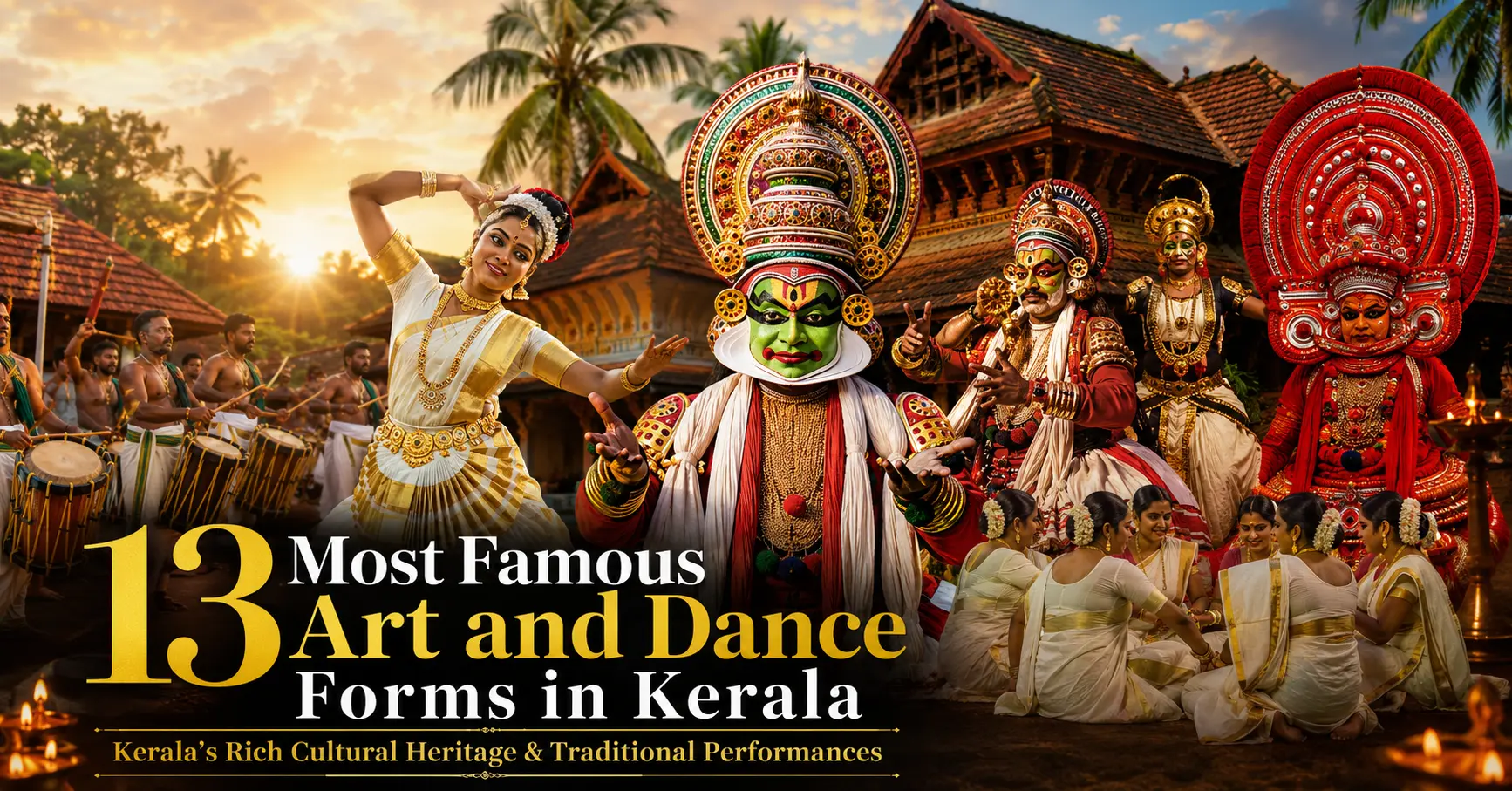
Kerala produces more classical and folk dance traditions than any other Indian state. Furthermore, two of these traditions hold UNESCO Intangible Cultural Heritage status. Most notably, the Kerala dance form traditions here range from 500-year-old classical theater to all-night ritualistic performances conducted in village temples under firelight.
As a result, every visitor to Kerala gains access to a living cultural archive. This guide covers all 13 forms – with history, UNESCO status, distinctive features, and where to watch each one.
What You Will Learn
- The 13 most famous kerala dance form traditions from classical to folk
- History, origin, and distinctive features of each art form
- Where to watch kathakali in kerala and theyyam kerala as a visitor
- Which forms carry UNESCO Intangible Cultural Heritage recognition
- How each kerala dance connects to mythology, temple ritual, or social celebration
- A traveler-type guide matching dance forms to visitor interests
Why Kerala’s Dance Forms Are Unlike Any Other in India
Kerala’s dance traditions connect to three distinct roots. Furthermore, these roots are Sanskrit classical theater, temple ritual, and tribal folk celebration.
The Natyashastra – India’s ancient Sanskrit treatise on performing arts – directly influenced Kerala’s classical forms. Most notably, Kerala’s temple culture preserved these art forms during periods when other Indian states lost them entirely.
As a result, Kerala today houses the largest active community of classical and folk performers in South India. In particular, two forms – Kutiyattam and Mohiniyattam – hold UNESCO Intangible Cultural Heritage recognition. Furthermore, the active training centers across the state ensure these traditions pass to new generations rather than remaining in archives.
Kathakali in Kerala: The Crown Jewel of Classical Dance
Kathakali in Kerala is the most globally recognized of all Kerala dance forms. Furthermore, the tradition combines dance, music, and drama into a theatrical experience unlike any other classical form in India.
What Is Kathakali?
Kathakali translates to “story-play” in Malayalam. Furthermore, male performers present this 500-year-old classical dance theater tradition. Musicians, singers, and dancers perform together as one unified ensemble.
Most notably, a kathakali in kerala performance requires a minimum of 5 to 8 trained performers at any time. Performers depict characters from the Ramayana and Mahabharata through precise hand gestures called Mudras. Furthermore, over 500 Mudras exist in the Kathakali vocabulary – each conveying a distinct emotion, character, or narrative moment.
The Distinctive Costume and Makeup
Makeup artists apply the Chutti – a white paste frame – around the face over 4 to 6 hours before every performance. Furthermore, each character type carries a specific color code.
Green (Pachcha) represents noble heroes. Red (Kathi) represents villains. Most notably, the elaborate headdress weighs up to 5 kilograms – performers wear it for the full duration of the show without any break.
As a result, performers condition their necks and upper bodies through years of physical training before debuting on stage. Furthermore, the application of Kathakali makeup is itself considered a ritual art form with strict traditional procedures.
Where to Watch Kathakali in Kerala
Kerala Kathakali Centre in Fort Kochi presents daily shows at 5:30 PM. Furthermore, makeup artists begin demonstrations at 4:30 PM – allowing visitors to witness the full transformation before the performance begins.
Most notably, Kerala Kalamandalam in Thrissur trains classical performers and opens rehearsal halls to visitors daily. Additionally, Nishagandhi Dance Festival in Thiruvananthapuram presents Kathakali alongside Mohiniyattam and Kutiyattam every January.
Theyyam Kerala: The Living God Ritual of the North
Theyyam kerala is the most spiritually intense performing tradition in all of India. Furthermore, theyyam kerala performers do not simply portray deities – communities believe the performer becomes the actual deity during the ritual.
What Is Theyyam?
Scholars identify over 400 distinct Theyyam forms across North Kerala. Furthermore, communities in Kannur and Kasaragod districts conduct Theyyam rituals between November and May annually.
Most notably, theyyam kerala rituals take place in village temple courtyards rather than on constructed stages. As a result, visitors sit among devotees seeking blessings from the performer-deity rather than watching from audience seats. Furthermore, this immersive quality makes Theyyam the most authentic cultural experience available anywhere in Kerala.
The Extraordinary Costume and Transformation
Artisans spend 3 to 5 days crafting headgear for major Theyyam forms. Furthermore, some headgear reaches 20 to 30 feet in height – requiring special engineering to balance during active performance.
Performers wear red and gold body paint, elaborate wooden masks, and multilayered fabric skirts. Most notably, the Muchilottu Bhagavathi Theyyam requires performers to walk on fire during the ritual. As a result, years of spiritual and physical preparation precede each performance of this specific form.
Furthermore, different Theyyam deities require entirely different makeup systems. Specifically, the Pottan Theyyam uses minimal makeup while the Kari Chamundi form covers the performer’s entire body in black and red pigments.
Where to Witness Theyyam in Kerala
The Theyyam season runs from November through May. Furthermore, Kannur district hosts the highest concentration of active performance venues across this period.
Most notably, the Parassinikadavu Muthappan Temple near Kannur conducts Theyyam daily – making it the most accessible Theyyam Kerala experience for any visitor. Additionally, travel agents in Kannur arrange village visits during peak season. Furthermore, the North Kerala Tourism website publishes a temple-by-temple Theyyam calendar updated each November.
Mohiniyattam: The Dance of the Enchantress
Mohiniyattam is Kerala’s premiere classical dance form for women. Furthermore, UNESCO recognized it as a globally significant art form, inscribing it on the Intangible Cultural Heritage list.
What Is Mohiniyattam?
Female performers practice Mohiniyattam. Furthermore, the name translates to “dance of Mohini” – the female avatar Lord Vishnu adopted to enchant the demon Bhasmasura.
This classical kerala dance form emphasizes graceful, flowing movements over angular precision. Most notably, the Lasya style – soft, lyrical, and feminine – defines every Mohiniyattam movement sequence. As a result, Mohiniyattam appears fundamentally different from Bharatanatyam or Odissi despite sharing Sanskrit classical roots.
Distinctive Features
White and gold Kasavu fabric distinguishes the Mohiniyattam costume from all other Indian classical dance forms. Furthermore, performers wear a single white jasmine garland woven into a circular bun on the left side of the head.
The Cholkettu – the opening prayer sequence – follows precise rules of posture, eye movement, and hand placement. Most notably, the eye movements in Mohiniyattam receive independent training for the first two years of study. As a result, a trained Mohiniyattam dancer communicates narrative through eye movement alone in certain sequences.
Where to Watch Mohiniyattam in Kerala
Kerala Kalamandalam in Thrissur teaches and performs Mohiniyattam. Furthermore, the academy accepts international students for residential programs lasting 3 months to 3 years.
Most notably, Thiruvananthapuram’s Nishagandhi Dance Festival in January hosts Mohiniyattam as a headline performance. Additionally, Drishyavedi Cultural Centre in Thrissur presents monthly classical dance performances featuring Mohiniyattam throughout the year.
Kutiyattam: Kerala’s UNESCO Heritage Sanskrit Theater
Kutiyattam is the oldest surviving Sanskrit theater tradition in the world. Furthermore, UNESCO recognized it as Intangible Cultural Heritage in 2001 – the first Indian performing art to receive this designation.
What Is Kutiyattam?
Performers enact stories from Sanskrit plays composed between the 1st and 10th centuries. Furthermore, a single act of Kutiyattam can last 40 consecutive days in its full traditional form.
Most notably, performers begin training in childhood. They train for 10 to 15 years before their first public performance. As a result, the total number of active Kutiyattam masters at any time remains very small – under 100 fully qualified practitioners exist globally today.
Instruments and Performance Space
Kutiyattam uses specific instruments – the Mizhavu barrel drum, Kuzhitalam cymbals, and Kurumkuzhal wind instrument. Furthermore, performers traditionally present Kutiyattam only in specific temple theaters called Kuttampalams.
Most notably, the Kalamandalam Margi in Thiruvananthapuram remains the primary active center for Kutiyattam practice today. Additionally, the Moozhikkulam Kuttambalam near Ernakulam hosts traditional temple-space Kutiyattam performances several times annually.
Koodiyattam: Combined Acting of Ancient Kerala
Koodiyattam means “combined acting.” Furthermore, both male and female performers present this Sanskrit theater form together – making it distinct from Kutiyattam’s traditional gender separation.
What Is Koodiyattam?
Temple authorities historically restricted Koodiyattam to Kuttampalam theater spaces within Hindu temples. Furthermore, Koodiyattam shares UNESCO recognition alongside Kutiyattam as a globally protected art form.
Most notably, Koodiyattam performers master sophisticated breathing control and precise facial muscle movements. Furthermore, a single facial expression in Koodiyattam can convey 12 distinct emotional states simultaneously through layered technique.
Performance Environment
Koodiyattam performances traditionally use oil lamps rather than electric lighting. As a result, the flickering light creates a visual atmosphere unchanged for over 1,000 years. Furthermore, the acoustic design of traditional Kuttampalam theaters amplifies the Mizhavu drum without any electronic assistance.
Most notably, the Irinjalakuda Koodalmanikyam Temple in Thrissur district conducts one of the most authentic traditional Koodiyattam performances accessible to visitors annually in February.
Ottamthullal: The People’s Satirical Dance
Ottamthullal is Kerala’s democratic art form. Furthermore, poet Kunjan Nambiar created it in the 18th century as a satirical commentary on social hierarchies using simple Malayalam language instead of Sanskrit.
What Is Ottamthullal?
Performers combine storytelling, satire, mime, and dance in a single continuous 2-hour performance. Furthermore, the content historically targeted social inequalities and religious hypocrisy.
Most notably, Ottamthullal performers wear green makeup and distinctive pleated white skirts. As a result, the visual style is immediately recognizable even to first-time viewers. Furthermore, performers deliver political commentary through humor – a tradition that contemporary performers maintain using modern social themes.
Current Status
The Ottamthullal tradition faces preservation challenges. That said, Kerala Kalamandalam actively trains new performers in the tradition. Furthermore, the form appears prominently in Thrissur and Palakkad district festivals during the Onam season every August.
Thiruvathirakali: The Women’s Circle Dance of Onam
Thiruvathirakali is Kerala’s most widely practiced community dance form. Furthermore, women perform it across every district of the state during the festival calendar.
What Is Thiruvathirakali?
Women perform Thiruvathirakali in a circle around a Nilavilakku – a tall brass oil lamp. Furthermore, performers clap hands rhythmically and sing devotional songs simultaneously throughout the dance.
This Kerala dance form celebrates marital fidelity and feminine energy. Most notably, performers dance during the Malayalam month of Dhanu (December-January) specifically. Furthermore, communities connect the dance to the story of restoring Kamadeva – the God of Love – to life after Lord Shiva reduced him to ashes.
Where to Witness Thiruvathirakali
Women’s groups perform Thiruvathirakali at Onam celebrations across Kerala. Furthermore, cultural centers in Thiruvananthapuram organize formal performances during the festival season.
Most notably, hotels across Kerala organize Thiruvathirakali demonstrations during Onam week for visiting guests. Additionally, the Kerala Tourism Cultural Fest in Thiruvananthapuram features Thiruvathirakali as a highlight performance every August.
Padayani: The Temple Warrior Dance of Central Kerala
Padayani is one of Kerala’s most visually dramatic ritual art forms. Furthermore, the giant Kolam headdresses performers wear rank among the most extraordinary costume constructions in any Indian art form.
What Is Padayani?
Padayani performers wear giant Kolam – figurative mask headdresses representing deities, demons, and mythological characters. Furthermore, each Kolam takes artisans 2 to 3 days to construct from bamboo, palm leaves, and natural pigments.
Communities in Pathanamthitta district conduct Padayani rituals in Bhagavathi temples. Most notably, the festival season runs from February through April. As a result, this specific window is the only opportunity for visitors to experience authentic Padayani performances.
The Distinctive Kolam Costumes
Artisans follow strict iconographic rules passed through generations for each deity figure. Furthermore, the Bhima Kolam – a giant warrior figure – stands over 10 feet tall when worn by the performer.
Most notably, the Kalan Kolam representing the God of Death uses solid black and red pigments across a 6-foot face construction. As a result, Padayani performances create an overwhelming visual intensity unlike any other kerala dance form.
Poorakkali: The Circular Warrior Dance
Poorakkali is Kerala’s martial community dance form. Furthermore, male performers present it in a circular formation carrying swords and shields.
What Is Poorakkali?
Performers depict ancient battle formations from Kerala’s Nair martial tradition. Furthermore, communities in Malabar conduct Poorakkali primarily during the Holi festival season.
Most notably, the synchronized sword movements create a complex visual spectacle – as a result, Poorakkali performances draw large community gatherings across North Kerala. Furthermore, the dance connects to the Kalaripayattu martial arts tradition that historically shaped Kerala’s warrior communities.
Tholpavakoothu: Shadow Puppet Theater of Kerala
Tholpavakoothu is Kerala’s ancient shadow puppet theater tradition. Furthermore, artists use leather puppets to tell the complete Ramayana across a backlit screen.
What Is Tholpavakoothu?
The complete Ramayana cycle takes 21 nights to perform in its full traditional form. Furthermore, puppet makers craft each figure from processed deer or goat leather.
Most notably, a single puppet requires 6 to 12 hours of cutting, painting, and jointing work. As a result, families in Palakkad district maintain this tradition across generations with the same puppets serving multiple decades of performance.
Where to See Tholpavakoothu
The Koonathara Tholpavakoothu Museum in Palakkad presents demonstrations for visitors. Furthermore, the Shoranur Art Museum houses one of the finest puppet collections in Kerala.
Most notably, the Bhagavathi Temple in Shoranur, Palakkad, conducts the full Ramayana puppet cycle annually between February and May. Additionally, the Thrissur Pooram festival week includes Tholpavakoothu demonstrations at the cultural program venues near Vadakkumnathan Temple.
Kavadiyattam: The Peacock Offering Dance
Kavadiyattam is a devotional dance form connected to Lord Subramanya. Furthermore, devotees perform it while carrying Kavadi – a decorated arch adorned with peacock feathers – on a long pole.
What Is Kavadiyattam?
Devotees perform Kavadiyattam as an act of devotional offering at Subramanya temples. Furthermore, performers wear saffron robes and carry the Kavadi while singing devotional songs.
Most notably, the singing accompanies the physical strain of carrying the decorated arch over long distances. As a result, Kavadiyattam represents a form where devotional intention and physical endurance combine into a single expression.
Kolkali: The Stick Dance of Malabar
Kolkali is North Kerala’s rhythmic stick dance tradition. Furthermore, Muslim communities in Kerala’s Malabar region originally developed this form as a community celebration.
What Is Kolkali?
Performers strike decorated sticks together in rhythmic patterns while dancing in a circle. Furthermore, Kolkali communities practice this form primarily in Malabar and Moplah regions of North Kerala.
Most notably, performers number between 12 and 24 in a single circle. As a result, the synchronized stick-striking creates a complex percussive rhythm without any accompanying drum. Furthermore, Kolkali accompanies weddings and Eid celebrations across the Malabar region annually.
Krishnanattam: The Eight-Night Krishna Cycle
Krishnanattam is Kerala’s most controlled classical tradition. Furthermore, the Guruvayur Devaswom Trust in Guruvayur manages all Krishnanattam performances exclusively.
What Is Krishnanattam?
Performers present the complete life of Lord Krishna across 8 consecutive nights. Furthermore, the Zamorin of Kozhikode commissioned Krishnanattam in the 17th century.
Most notably, this makes Krishnanattam the only classical Kerala dance form still controlled by a single temple trust. As a result, the Guruvayur Temple is the only venue in the world where visitors can witness authentic Krishnanattam.
Connection to Kathakali
Krishnanattam directly influenced the development of Kathakali. Furthermore, costume and makeup conventions from Krishnanattam transferred directly into early Kathakali traditions.
Most notably, scholars identify Krishnanattam as the artistic template from which Kathakali evolved during the 17th century. As a result, understanding Krishnanattam provides critical context for appreciating Kathakali’s visual language.
Quick Reference Guide: All 13 Kerala Dance Forms
|
Dance Form |
Type |
Region |
Best Venue |
Season |
|
Kathakali |
Classical |
Central Kerala |
Fort Kochi, Thrissur |
Year-round |
|
Theyyam |
Ritual |
North Malabar |
Kannur, Kasaragod |
Nov to May |
|
Mohiniyattam |
Classical |
Central Kerala |
Thiruvananthapuram |
Year-round |
|
Kutiyattam |
Classical Sanskrit |
Temple Kerala |
Thiruvananthapuram |
Year-round |
|
Koodiyattam |
Classical Sanskrit |
Temple Kerala |
Thrissur, Irinjalakuda |
Year-round |
|
Ottamthullal |
Folk |
Central Kerala |
Thrissur, Palakkad |
Onam season |
|
Thiruvathirakali |
Folk Women |
Statewide |
Cultural centers statewide |
Dhanu month |
|
Padayani |
Ritual |
Pathanamthitta |
Pathanamthitta district |
Feb to Apr |
|
Poorakkali |
Folk Martial |
North Kerala |
Malabar district |
Holi season |
|
Tholpavakoothu |
Shadow Puppet |
Palakkad |
Shoranur Temple |
Feb to May |
|
Kavadiyattam |
Ritual Devotional |
Statewide |
Subramanya Temples |
Festival season |
|
Kolkali |
Folk |
North Kerala |
Malabar |
Weddings, festivals |
|
Krishnanattam |
Classical Temple |
Guruvayur |
Guruvayur Temple only |
Year-round |
Kerala Dance Forms by Traveler Type
For First-Time Kerala Visitors
First, book a Kathakali demonstration at Kerala Kathakali Centre in Fort Kochi. Furthermore, the makeup demonstration before the show adds significant educational value.
Most notably, Fort Kochi’s cultural district places Kathakali, spice markets, and heritage churches within walking distance. As a result, first-time visitors cover both cultural and heritage experiences in a single afternoon.
For Cultural and Spiritual Travelers
Theyyam kerala rituals provide the most immersive spiritual experience of any performing art in India. Furthermore, witnessing a deity embodiment ceremony in a village temple connects visitors to a living tradition unchanged for centuries.
Most notably, combining a Theyyam visit with Parassinikadavu Temple creates a complete North Kerala cultural experience. As a result, we recommend spending 2 to 3 nights in Kannur specifically to access multiple Theyyam performances across different temples.
For Classical Arts Enthusiasts
Kerala Kalamandalam in Thrissur remains the finest residential arts institution in South India. Furthermore, the campus hosts all major classical forms including Kathakali, Mohiniyattam, and Kutiyattam.
Most notably, the Kalamandalam Museum houses 5,000 artifacts from 200 years of Kerala performing arts history. Additionally, the campus accepts visitors for guided tours on weekday mornings between 9 AM and 12 PM.
For Festival Travelers
The Nishagandhi Dance Festival in January in Thiruvananthapuram presents all major Kerala dance forms across 10 consecutive evenings. Furthermore, international classical artists also perform alongside Kerala masters during the festival.
Most notably, the Thrissur Pooram in April includes Thiruvathirakali, Poorakkali, and Ottamthullal within a single festival week. As a result, April in Thrissur offers the highest density of live kerala dance performances available at any single location in the state.
UNESCO Recognition and Global Significance
Which Kerala Dance Forms Hold UNESCO Recognition
UNESCO listed Kutiyattam as Intangible Cultural Heritage in 2001. Furthermore, this was the first Indian performing art to receive this designation globally.
Mohiniyattam joined the UNESCO Representative List in 2010. Most notably, UNESCO specifically cited Kerala’s temple culture as the primary preservation mechanism for both forms. Consequently, both traditions continue receiving international conservation funding and global documentation support.
Why UNESCO Recognition Matters for Visitors
UNESCO recognition confirms global cultural significance. Furthermore, it directs international preservation funding toward training new performers and maintaining traditional venues.
Most notably, recognized art forms appear in international cultural festivals from Paris to Tokyo. As a result, travelers familiar with these festivals often prioritize experiencing the kerala dance form tradition at its authentic source in Kerala. Furthermore, UNESCO documentation provides visitors with access to detailed performance archives unavailable for unrecognized traditions.
Best Time to Experience Kerala Dance Forms
|
Season |
Best Months |
Dance Forms Active |
Honest Assessment |
|
Winter |
Nov to Feb |
Theyyam, Thiruvathirakali, Krishnanattam |
Best overall – all forms active |
|
Festival Season |
Aug to Sep |
Ottamthullal, Thiruvathirakali, Poorakkali |
Onam brings statewide cultural activity |
|
Temple Season |
Feb to May |
Padayani, Tholpavakoothu, Kavadiyattam |
Regional temple circuit at peak |
|
Year-round |
All months |
Kathakali, Mohiniyattam, Kutiyattam |
Always accessible at cultural centers |
Why November to February Is the Peak Cultural Season
November to February brings cool weather and active Theyyam season simultaneously. Furthermore, this combination creates the finest conditions for both outdoor and indoor performance experiences.
Most notably, the Thrissur cultural calendar between November and January hosts more classical performances per week than any other period. As a result, visitors who plan Kerala trips between November and February access the full range of the state’s active Kerala dance traditions.
Year-Round Accessibility Through Cultural Centers
Kathakali, Mohiniyattam, and Kutiyattam performances run year-round at established cultural centers. Furthermore, Fort Kochi’s performance venues operate 52 weeks annually without seasonal closure.
Most notably, this year-round accessibility makes these three classical forms the most practical entry point for visitors traveling to Kerala outside the November to February peak window. As a result, no travel timing completely excludes visitors from experiencing a genuine Kerala dance form performance.
Conclusion
Kerala dance form traditions represent 2,000 years of unbroken artistic inheritance. Furthermore, no other Indian state preserves this combination of classical, ritual, and folk performance art in active daily practice.
Most notably, visitors who witness a Theyyam ritual in Kannur or a Kathakali performance in Fort Kochi carry a cultural experience that no museum or documentary can replicate. Furthermore, the UNESCO-recognized forms – Kutiyattam and Mohiniyattam – provide access to art traditions that artists in Paris and Tokyo travel to Kerala specifically to study.
Plan the Theyyam visit for November. Book the Kathakali demonstration before you land. Most notably, allow Kerala’s performing arts the time they genuinely deserve. Above all, each kerala dance form rewards patience – the longer you watch, the more deeply you understand what you are seeing.