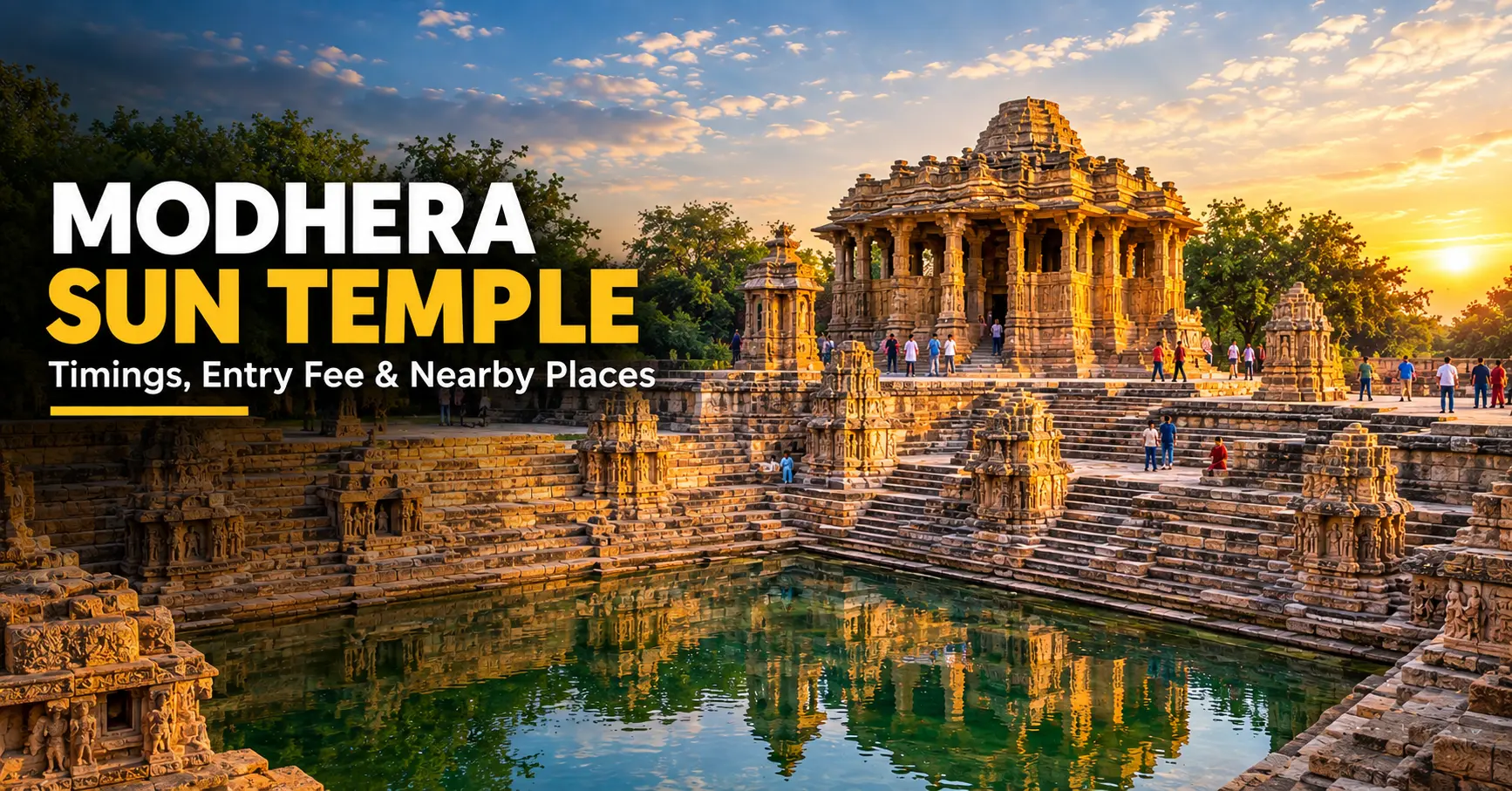
Gujarat holds one of India’s finest surviving examples of sun worship architecture. Furthermore, Modhera Sun Temple aligns its inner sanctum precisely with the sun’s equinox rays.
Most notably, sources disagree slightly on entry fees and distances, so this guide clarifies everything honestly. Read on for history, timings, nearby places, and where to stay.
What You Will Learn
- What Modhera Sun Temple, also called Surya Mandir Modhera, represents
- Modhera Sun Temple history and architecture across three sections
- Modhera Sun Temple timings and honest entry fee details
- Best time to visit Modhera Sun Temple for weather and festivals
- Modhera Sun Temple nearby places worth pairing with your visit
- Hotel and resort near Modhera Sun Temple options
What Is Modhera Sun Temple?
King Bhimdev I of the Solanki dynasty built this temple in 1026 AD, dedicating it to Surya, the Sun God. This construction marked one of the finest architectural achievements of the Solanki era in Gujarat.
Most notably, the temple sits on the banks of the Pushpavati River, surrounded by a landscaped garden. This riverside setting adds a genuinely peaceful backdrop to an already striking historical monument.
UNESCO added this temple to its World Heritage List in 2014, recognizing its architectural and historical significance. This recognition placed Modhera alongside India’s most celebrated heritage sites worldwide.
Today, no active worship takes place here, since the Archaeological Survey of India protects the site as a monument. Visitors experience it purely as a heritage landmark rather than a functioning place of worship.
Surya Mandir Modhera: History and Architecture
Mahmud Ghazni plundered the shrine, though its architecture survived largely intact despite the historical invasion. This resilience makes the temple’s surviving craftsmanship even more remarkable to witness firsthand.
Most notably, Solanki architects designed the sanctum to catch the sun’s first rays each equinox directly on the idol. This precise alignment reflects a genuinely advanced understanding of astronomy for its era.
The complex is divided into three sections: Surya Kund, Sabha Mandapa, and Guda Mandapa, each serving a distinct purpose. Together, these sections create a cohesive architectural journey from entrance to inner sanctum.
Intricate carvings throughout depict scenes from the Ramayana, Mahabharata, and daily life during the Solanki era. Sculptors also carved dancers, mythical creatures, and floral patterns across nearly every visible surface.
On the summer solstice, sunlight reportedly falls directly above the temple at noon, casting no shadow at all. This detail further confirms the extraordinary astronomical precision behind the original construction.
Surya Kund Stepwell
This stepped reservoir spans roughly 21,000 square feet, once serving as a ceremonial bathing spot for visitors. Pilgrims traditionally purified themselves here before entering the main temple complex for worship.
Most notably, over 100 smaller shrines line its steps, each dedicated to different Hindu deities. This concentration of miniature shrines makes the stepwell feel like a temple complex in its own right.
Modhera Sun Temple Timings
Most sources confirm the temple opens from 7 AM to 6 PM daily, though hours can shift seasonally. Planning your visit around these hours ensures enough daylight to explore the full complex.
Most notably, one source describes timings simply as sunrise to sunset, so confirming locally remains wise. Seasonal daylight changes across Gujarat can genuinely affect exact opening and closing times.
Officials restrict photography inside the main sanctum, though the surrounding complex remains open for photos. This rule preserves the sanctity of the inner shrine while still allowing visitors to capture memories.
A small on-site museum and interpretation center displays artifacts and information panels about the temple’s construction. It generally follows the same operating hours as the main complex itself.
Light and Sound Show
Arrive around 4 PM to watch the temple glow under changing evening light before sunset. This golden hour timing consistently produces the most photogenic view of the entire structure.
Most notably, staying past 7 PM rewards visitors with an illuminated light and sound show narrating the temple’s history. This evening program adds genuine narrative depth beyond a simple daytime walkthrough.
Modhera Sun Temple Entry Fee
Sources report Indian national tickets at approximately ₹25, with foreign tourists paying around ₹300. This pricing structure follows the standard ASI model used across many protected Indian monuments.
Most notably, children under 12 years typically enter free of charge at this UNESCO site. This policy makes the temple genuinely accessible for families traveling with young children.
As a result, confirming current pricing at the official ASI counter or online booking portal remains genuinely useful. Prices at heritage sites occasionally shift, so checking ahead avoids any surprise at the gate.
Visitors also book e-tickets online or buy them directly at the counter, whichever suits their travel style. Online booking often comes at a slightly discounted rate compared to counter purchases.
Entry Fee Reference Table
| Visitor Type | Approximate Fee |
| Indian nationals | ₹25 (verify current rate) |
| SAARC and BIMSTEC nationals | Nominal, varies by source |
| Foreign nationals | Approximately ₹300 |
| Children under 12 | Free |
Best Time to Visit Modhera Sun Temple
October through March delivers the most pleasant weather for exploring this open-air heritage complex. Cooler temperatures during these months make walking the grounds genuinely comfortable throughout the day.
Most notably, visiting during the Modhera Dance Festival in January adds classical dance performances to your trip. This three-day government-organized festival transforms the temple grounds into a vibrant cultural stage.
Avoid the peak summer months between April and June, when daytime heat makes outdoor exploration uncomfortable. Gujarat’s summer temperatures can genuinely limit how long visitors want to spend outdoors.
Most notably, equinox days in March and September offer a rare chance to witness the temple’s original astronomical alignment firsthand. Travelers interested in this phenomenon should plan their visit specifically around these dates.
Modhera Sun Temple Nearby Places
Rani Ki Vav, an intricately carved stepwell in Patan, sits a short drive from Modhera and shares UNESCO status. This pairing creates one of Gujarat’s strongest heritage day-trip combinations available.
Most notably, Patan itself is renowned for Patola silk sarees alongside its own rich historical monuments. A stop here adds both cultural shopping and additional sightseeing to your itinerary.
Taranga Hills offers ancient Jain temples and panoramic views for travelers wanting a spiritual, scenic extension. This destination suits visitors with an extra day to explore beyond Modhera and Patan.
As a result, combining all three stops creates a genuinely complete heritage circuit across North Gujarat. Most travelers comfortably cover this route within a single well-planned day trip.
Extending your Gujarat heritage trip? Explore more places to visit near Vadodara for additional destinations.
Hotel and Resort Near Modhera Sun Temple
Limited accommodation exists directly in Modhera village, so most visitors base themselves in nearby Mehsana or Patan. This arrangement suits travelers wanting a comfortable base with wider dining and transport options.
Most notably, Mehsana offers a wider range of hotels and resorts within a comfortable driving distance. Budget and mid-range properties both remain readily available throughout this nearby city.
As a result, day-trip visits from Ahmedabad or an overnight stay in Mehsana both work well for most travelers. Choosing between the two ultimately depends on how much time you want to dedicate to the region.
A resort near Modhera Sun Temple specifically remains rare, so Patan’s heritage-adjacent stays often serve as the closest alternative. These properties combine proximity with genuine Gujarati hospitality and local cuisine.
Planning your Gujarat stay? Read how to reserve your accommodation with zero prepayment for maximum flexibility.
How to Reach Modhera Sun Temple
Sources cite Ahmedabad as roughly 100 km away, about two and a half hours by road. This distance makes Modhera a genuinely manageable day trip from Gujarat’s largest city.
Most notably, Mehsana Junction sits closer, approximately 28 to 30 km from the temple. Travelers arriving by train often find Mehsana the most practical connecting point for onward road travel.
Becharaji railway station offers the nearest rail link, sitting just 15 km from Modhera village. Local buses and rental cabs both connect this station to the temple reliably.
As a result, most visitors combine a short train journey with a final stretch by road to complete their trip. This combination keeps the journey both affordable and reasonably quick overall.
Quick Reference: Modhera Sun Temple at a Glance
| Detail | Information |
| Built | 1026-1027 AD, by King Bhimdev I |
| Dedicated to | Surya, the Sun God |
| UNESCO status | Added in 2014 |
| Timings | Approximately 7 AM to 6 PM (verify locally) |
| Entry fee | ₹25 Indians, ₹300 foreign nationals (verify current rate) |
| Best season | October to March |
| Nearest railway station | Becharaji, 15 km |
| Nearest major junction | Mehsana, 28 to 30 km |
Conclusion: Visiting Modhera Sun Temple
Modhera Sun Temple rewards visitors with a rare blend of astronomical precision and Solanki-era craftsmanship. Furthermore, pairing this visit with Rani Ki Vav and Patan creates a genuinely complete heritage day.
Confirm current entry fees before you go. Visit between October and March for the best weather.