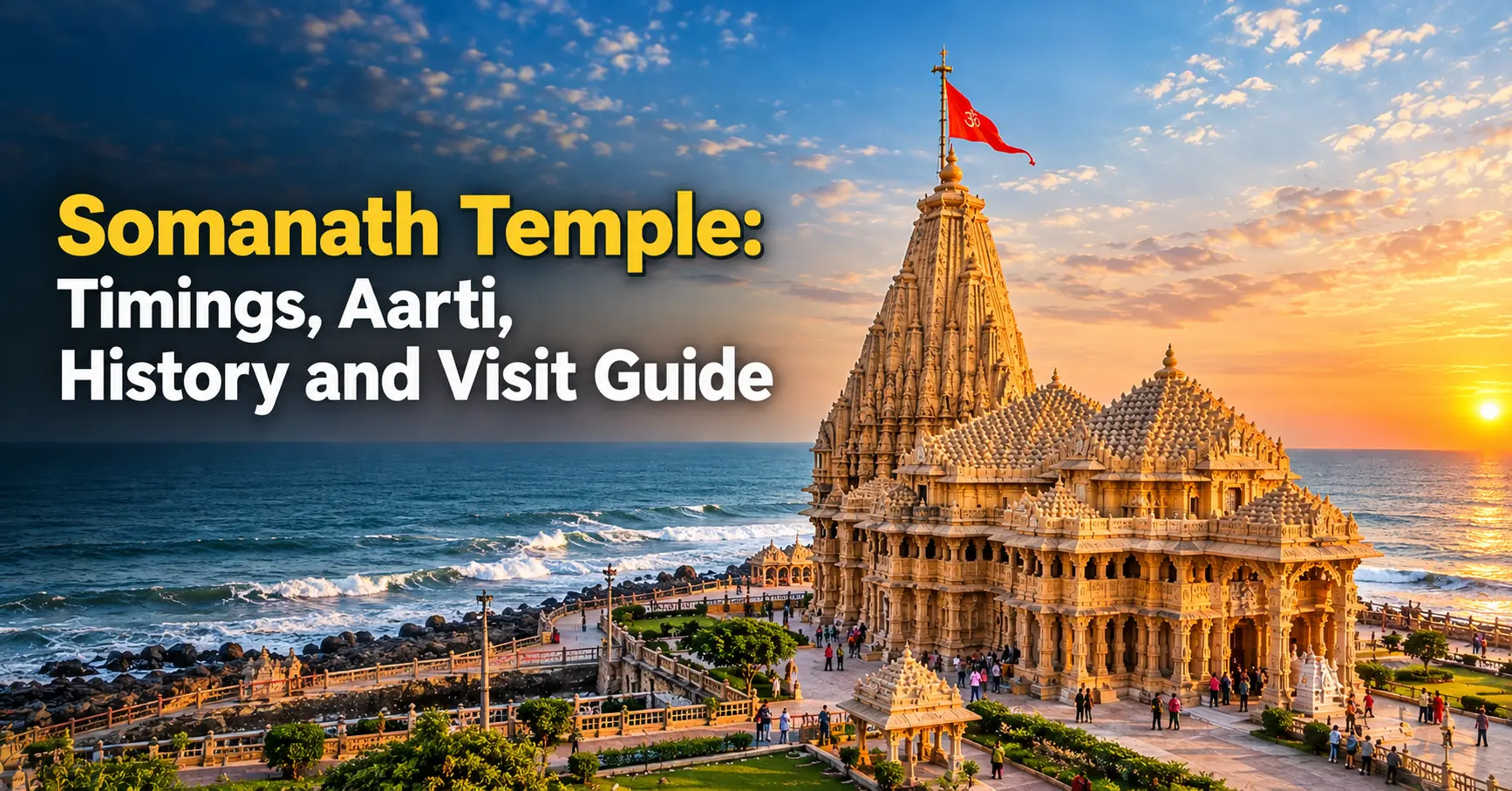
Somanath Temple in Gujarat is the first of India’s twelve Jyotirlingas, standing on the Arabian Sea coast at Veraval in Gir Somnath district. Pilgrims call it Somnath Mandir.
This guide covers timings, aarti, the light show, dress code, history, nearby places and travel routes. Where sources disagree, the article says so, so you can verify before you go.
What You Will Learn
- How the Gujarat temple differs from similar names
- Darshan, aarti and light show timings
- Rules on phones, dress and lockers
- History from 1026 to the 1951 temple
- How to reach and what to see nearby
What Is Somanath Temple?
Somanath Temple is a Shiva temple at Prabhas Patan near Veraval, Gujarat. Devotees regard it as the first of twelve Jyotirlingas, making it a major pilgrimage site.
The present building dates from 1951 and stands beside the sea. Visitors come for darshan, the evening aarti, the coastal setting and the long history of rebuilding.
Somanath vs Somnath vs Somanathapura
Names cause confusion, so here is a quick guide. The spelling “Somanath” is common in searches, but several temples share similar names.
| Name | Where | What it is |
| Somanath or Somnath Temple | Veraval, Gujarat | First Jyotirlinga, covered here |
| Somanathapura (Chennakeshava) | Karnataka | Hoysala temple, Vishnu |
| Thiruneedur Somanathaswami | Tamil Nadu | Separate Shiva temple |
This article covers only the Gujarat temple at Prabhas Patan, the one most travelers mean when they search for Somnath.
Somanath Temple Timings and Aarti Schedule
The Shree Somnath Trust lists darshan from 6 AM to 10 PM. Some travel blogs give earlier closing times, such as 9 or 9:30 PM, so verify on the day.
| Ritual | Reported time |
| Darshan | 6 AM to 10 PM (Trust) |
| Morning aarti | 7 AM |
| Noon aarti | 12 noon |
| Evening aarti | 7 PM |
| Light and sound show | About 8 PM to 9 PM |
The aarti times match across the Trust and several guides. However, the light show varies, and the Trust says it does not run during the monsoon.
Entry to the temple is free, according to the Trust. Special poojas and some priority services carry separate charges, so confirm rates officially.
Somanath Jyotirlinga: Significance and Legend
Devotees describe a Jyotirlinga as a radiant sign of Lord Shiva. Twelve such shrines exist across India, and Somanath holds the first position in the traditional list.
Local belief links Prabhas Patan to the moon god, Soma, who worshipped Shiva here. The name Somnath means “Lord of the Moon” in common explanation.
The shore also holds Krishna traditions, which gives the town a wider religious setting. Pilgrims often combine darshan with a visit to the nearby sacred sites.
History of Somanath Temple
The temple has a long record of destruction and rebuilding. Wikipedia lists several attacks, and each time devotees and rulers restored the shrine.
Destruction and Rebuilding
Key dates from Wikipedia’s history of the site include the following, though historians still debate the details of several episodes in this long record:
- 1026: Mahmud of Ghazni raids the temple.
- 1169: Kumarapala rebuilds it.
- 1299: Ulugh Khan attacks during Alauddin Khalji’s rule.
- 1308: Mahipala I rebuilt the shrine.
- 1395: Muzaffar Shah I destroys it.
- 1706: Aurangzeb orders its destruction.
Historians debate details of some episodes. Therefore, treat this list as a summary and consult scholarly sources for deeper study.
The 1951 Temple
Construction of the current temple began in 1950. Sardar Vallabhbhai Patel started the effort after Junagadh joined India, and work finished in May 1951.
President Rajendra Prasad performed the installation ceremony on 11 May 1951. Prabhashankarbhai Oghadbhai Sompura designed the temple in the Māru-Gurjara, or Chaulukya, style.
Architecture and What to See Inside
The main spire rises about 15 metres above the sanctum, with a flagpole of roughly 8.2 metres on top. The temple uses a pillared hall and carved relief panels.
Inside, the focus is the Jyotirlinga in the sanctum. Outside, the sea wall and the open courtyard give the best views of the waves.
Allow about one to three hours for darshan, depending on crowds. Weekdays outside festival periods usually move faster than weekends and Shravan days.
What Happens During Darshan?
Visitors join a queue, pass security checks and move toward the sanctum in a steady line. Staff keep the line moving, so darshan itself is brief.
On quiet weekdays, the process can take under an hour. During festivals, it can stretch much longer, so carry water and avoid bringing small children into dense crowds.
Priority darshan options exist, and Thomas Cook lists fees of ₹50 to ₹250. Confirm availability and rates at the counter, because rules can change.
Rules, Dress Code and Mobile Phones
The Trust bans mobile phones, cameras and other electronic devices inside the temple. You can store them free in the cloak room lockers near the entrance.
Photography is not allowed in the temple. The Trust says high-resolution photos can be bought separately, so you do not need your own camera.
Dress modestly. Traditional clothes such as sarees and dhotis are fine, but the Trust does not permit miniskirts or disrespectful dress. Smoking is also prohibited on the grounds.
Jay Somnath Light and Sound Show
An evening show narrates the temple’s story with light and sound near the sea wall. The Trust lists it from 8 PM to 9 PM, except during the monsoon.
Thomas Cook gives 7:45 PM to 8:45 PM and a ticket of about ₹30 to ₹50. Because timings and prices differ, confirm at the ticket counter.
Arrive early for good seating. Meanwhile, carry a light jacket in winter, because the sea breeze can feel cool after dark.
Poojas, Prasad and Room Booking
The Trust accepts online room bookings and pooja registrations only through somnath.org. It warns against fraudulent bookings through unofficial channels.
Prasad can be booked separately at somnathprasad.com. Never pay a stranger who offers priority darshan, and avoid links shared on social media.
Three Trust guest houses take online reservations: Sagar Darshan Atithi Gruh, Lilavati Atithi Bhavan and Maheshwari Atithi Bhavan. Each has a restaurant.
Best Time to Visit Somanath Temple
October to March is the most comfortable period, with mild weather and easier walking. Festivals such as Maha Shivratri bring large crowds during this window.
| Period | What to expect |
| October to February | Pleasant weather, good for darshan and sightseeing |
| Maha Shivratri | Heavy crowds, long queues |
| April to June | Hot and humid |
| July to September | Monsoon; the light show may stop |
For shorter queues, choose a weekday morning. Early darshan also gives calmer light for the walk along the sea wall.
How to Reach Somanath Temple
Somanath is well connected by rail and road. Airports are farther away, so most visitors arrive by train or car.
By Air
Diu Airport is the nearest, but sources quote 63, 80 and 85 km. Rajkot Airport is another option, roughly 195 km away. Check current flight schedules.
By Train
Somnath railway station lies very close to the temple, while Veraval Junction is about 7 km away. Autos and cabs cover the short ride.
Trains suit budget travelers and pilgrims on a tight schedule. Check current timetables and book early for festival dates, because seats on popular services sell out quickly.
By Road
State buses and private cabs link Somnath to major Gujarat cities. One guide lists these approximate road distances from nearby places.
| From | Distance |
| Porbandar | About 130 km |
| Rajkot | About 214 km |
| Dwarka | About 230 km |
| Ahmedabad | About 400 km |
Distances vary by route and source. Confirm the time with your driver before leaving, because highway traffic and stops change the total.
Places to Visit Near Somanath Temple
The temple town works best as a base for slow, unhurried sightseeing. Short distances mean you can see several places without rushing between them.
Several sacred and scenic stops sit within a short drive of the main temple. Most fit comfortably into a single day.
- Triveni Sangam: a confluence of three rivers near the sea, about 1.5 km away.
- Bhalka Tirth: the site linked to Krishna’s final moments, about 5 km away.
- Somnath Beach: a calm stretch beside the temple town.
- Prabhas Patan Museum: open 10:30 AM to 5:30 PM, with a small ticket.
- Gir National Park: a wildlife trip that needs separate bookings.
If you are continuing north, read our guide to beaches near Dwarka. You can also add Shivrajpur Beach near Dwarka for a quieter coastal break.
Somanath Temple Costs at a Glance
Temple entry is free, so a visit costs little. Extra spending depends on poojas, priority darshan, food and travel. Use these reported figures only as a guide.
| Item | Reported cost | Source note |
| Temple entry | Free | Shree Somnath Trust |
| Cloak room lockers | Free | Shree Somnath Trust |
| Priority darshan | ₹50 to ₹250 | Thomas Cook, verify |
| Light show | ₹30 to ₹50 | Thomas Cook, verify |
| Prabhas Patan Museum | ₹5 (Indians), ₹50 (foreigners) | Housing.com, verify |
Prices can change without notice, so confirm each cost at the counter on arrival and keep small notes ready.
Festivals and Crowds at Somanath Temple
Maha Shivratri is the busiest period, and devotees also gather in large numbers during the month of Shravan. Expect long queues, packed roads and fully booked rooms.
If you want a quieter visit, avoid these dates. Otherwise, arrive before sunrise, book accommodation weeks ahead and keep your plans flexible.
One-Day Itinerary for Somanath Temple
Start with early darshan and the 7 AM aarti, then walk the sea wall. Visit Triveni Sangam and Bhalka Tirth before the midday heat.
After lunch, rest or visit the museum. Return to the temple area by sunset, and stay for the 7 PM aarti.
Finish with the light show if it runs that evening. Then return to your hotel or continue by road toward Veraval.
Combining Somanath With Madhavpur and Dwarka
Many travelers link Somanath with a longer Saurashtra circuit. Madhavpur Beach lies roughly 73 to 75 km away, and Dwarka is about 230 km by road.
Porbandar sits between them, so it makes a practical overnight halt. Therefore, plan two or three days if you want temples, beaches and the Gir region together.
Where to Stay Near Somanath Temple
Staying close saves time on festival days and for early aarti. The Trust guest houses are the most direct choice for pilgrims.
Veraval has more hotels and eateries, about 7 km away. Book early for Maha Shivratri, Shravan month and long weekends, because rooms fill quickly.
Facilities and Accessibility
The Trust provides cloak rooms, guest houses with restaurants and baby cradle facilities. Beyond that, public facilities depend on crowds, so carry essentials.
Elderly visitors should plan for walking and queues. Ask temple staff about assistance on arrival, because arrangements may differ by day.
Practical Tips for Visiting
- Leave phones and cameras in the cloak room lockers.
- Wear modest, comfortable clothing and easy footwear.
- Carry water and a small amount of cash.
- Book rooms and poojas only through somnath.org.
- Plan for queues on weekends and festivals.
Conclusion
Somanath Temple combines pilgrimage, history and a sea-facing setting. Check timings, the light show and rules on the Trust’s official site before you travel.
Pair it with Triveni Sangam and Bhalka Tirth, and save this guide to plan your wider Saurashtra trip with more confidence.
Frequently Asked Questions
Where is Somanath Temple located?
What are the Somanath Temple timings?
Is there a dress code?
Is there an entry fee?
Are mobile phones allowed?
What time is the aarti?
How far is Somanath Temple from Dwarka?
What is the best time to visit?
Which airport is closest?