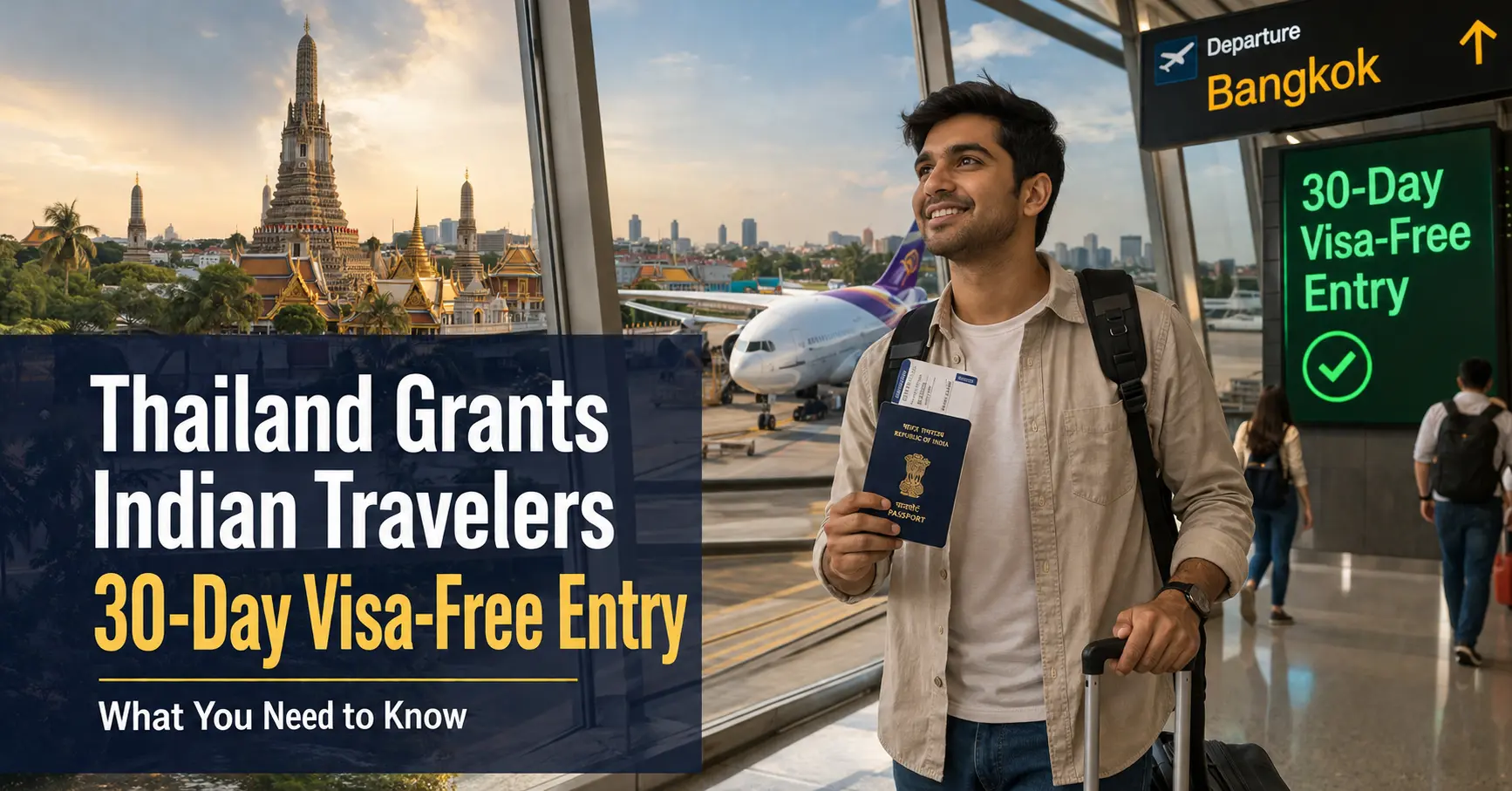
Indian travelers heading to Thailand are about to find the process a little simpler. The Thai Cabinet has approved a new visa exemption arrangement that places India in the 30-day visa-free category. This moves Indian citizens away from the Visa on Arrival system they have relied on for years.
This news matters for a market that sends hundreds of thousands of visitors to Thailand every year. It touches weekend getaways, honeymoon planning, and longer work-from-Thailand stints for digital nomads alike. Families budgeting a summer holiday, first-time travelers nervous about paperwork, and frequent flyers who visit Bangkok on business will all feel the difference.
The change has not taken effect yet. Thailand still needs to publish it in the Royal Gazette before it becomes law, and the Tourism Authority of Thailand (TAT) says further updates will follow once that happens. The policy direction is confirmed, though, so travelers planning trips in the coming months should understand exactly what is changing and why.
Key Takeaways
- Thailand’s Cabinet approved a 30-day visa exemption for Indian citizens, replacing the previous Visa on Arrival arrangement.
- This move forms part of a broader “one country, one entry category” overhaul from May 2026 that also ended Thailand’s 60-day visa exemption scheme.
- The rule isn’t in effect yet; it needs publication in the Royal Gazette, and officials haven’t announced an exact start date.
- Travelers who already hold an approved 60-day stay will keep that full period.
- Standard requirements – passport validity, proof of onward travel, accommodation details, and the Digital Arrival Card (TDAC) – remain in place.
- The change should lower costs and simplify planning for Indian tourists, families, honeymooners, and digital nomads.
What Has Changed?
The Old System
Until now, Indian citizens visiting Thailand for tourism generally entered through Visa on Arrival. That system required paying a fee at the airport or land border, and it typically capped stays at a shorter window. Thailand also ran a separate, temporary visa-free scheme for Indian travelers that expanded over time to allow stays of up to 60 days.
That 60-day exemption did not survive Thailand’s broader visa overhaul. Thai officials approved a sweeping restructuring of entry rules in May 2026, built around what they call a “one country, one entry category” principle. Every country now sits in exactly one of three groups under this framework: a 30-day visa exemption, a 15-day visa exemption, or Visa on Arrival, based on factors such as economic ties, tourism volume, and security assessments.
The New Policy
The latest Cabinet decision confirms where India lands in that new structure: the 30-day visa-free tier. Indian tourists will no longer need to apply for Visa on Arrival or pay the associated fee. Instead, they will enter Thailand without a visa and stay for up to 30 days, as long as they meet standard entry conditions.
Reports citing Thailand’s Tourism Minister, Surasak Phancharoenworakul, say the Cabinet approved the 30-day exemption to match the travel patterns of Indian tourists, who represent one of Thailand’s largest international visitor markets. He also indicated the government could review the arrangement later if problems arise. That suggests officials see this as an evolving policy rather than a permanent fixture.
Officials haven’t made an exact start date public as of this writing. The measure takes legal effect only after formal publication in the Royal Gazette, and Thai tourism officials say a specific date will follow separately. Travelers already in Thailand, or those who enter before the new rule takes effect, will keep whatever stay period they received at entry.
Why Thailand Made This Decision
Thailand’s tourism economy leans heavily on foreign arrivals, and Indian visitors have grown into an increasingly important part of that picture over the past decade. Placing India in the 30-day exemption category, rather than the shorter 15-day tier or Visa on Arrival, signals that Thai authorities view the Indian market as significant enough to warrant smoother access.
Officials have not confirmed every reason behind the decision. Tourism experts, though, believe it reflects a mix of factors: sustained growth in Indian outbound travel, Thailand’s interest in diversifying its visitor base beyond traditional East Asian markets, and a broader push toward what tourism leadership has described as “quality tourism” rather than sheer visitor volume. The shift away from the 60-day scheme, toward more standardized and shorter exemption windows overall, also points to a government trying to balance accessibility with tighter oversight of who enters and why.
Bilateral relations likely play a role too. Simplifying travel for one of Asia’s largest outbound tourism markets is a low-cost way to strengthen ties, especially as Thailand competes with destinations like Vietnam, Sri Lanka, and the Maldives for the same pool of Indian travelers.
What Indian Travelers Should Know
Even with visa-free entry, Thailand still expects travelers to meet standard immigration requirements. Indian visitors should keep the following in mind:
- Passport validity: Most countries, including Thailand, expect at least six months of validity remaining on a passport at the time of entry. Check this before booking flights.
- Proof of onward travel: A confirmed return or onward ticket is typically required, even under visa-free arrangements.
- Accommodation details: Immigration officers may ask for proof of where you are staying, whether that’s a hotel booking or a host’s address.
- Sufficient funds: Thai immigration has historically reserved the right to ask for evidence of adequate funds for the length of stay.
- Digital arrival card: Indian travelers should continue completing the Thailand Digital Arrival Card (TDAC) online before arrival, as this remains a requirement independent of the visa exemption change.
- Entry checkpoints: The exemption should cover Thailand’s international airports along with major land and sea checkpoints. Travelers should still confirm details once officials publish the Royal Gazette notification.
None of this is unusual for international travel. It’s worth double-checking before departure, though, especially while the new rule is still taking shape.
Benefits for Indian Tourists
The practical upside for Indian travelers is fairly direct. Skipping the Visa on Arrival fee lowers the upfront cost of a trip. Budget travelers and families managing group expenses feel that saving the most.
Airport queues shrink too, since one less form and one less payment step means less time standing in line. Honeymoon couples and short-holiday planners gain an easier booking process, without visa timelines to plan around. Business travelers can make last-minute trips without arranging documentation in advance. Digital nomads benefit most of all: a full month of visa-free stay gives them more room to settle into Thailand’s co-working hubs than a shorter exemption would.
Best Places to Visit in Thailand
Thailand’s appeal for Indian travelers spans everything from beach holidays to cultural sightseeing:
- Bangkok – The capital blends glittering temples like Wat Arun with modern shopping districts, street food markets, and a nightlife scene that rarely slows down.
- Phuket – Thailand’s largest island is known for resort-lined beaches, water sports, and easy day trips to nearby islands.
- Krabi – Famous for dramatic limestone cliffs, Railay Beach, and boat trips to lesser-visited coves.
- Chiang Mai – A cultural hub in the north, popular for its old-city temples, night markets, and cooler climate.
- Pattaya – Just a short drive from Bangkok, this coastal town draws families and short-break travelers with its beaches and theme parks.
- Koh Samui – This quieter island escape offers upscale resorts and wellness retreats.
- Ayutthaya – A UNESCO World Heritage site and former capital, ideal for a day trip focused on ancient ruins.
- Phi Phi Islands – Best known for turquoise water and snorkeling, typically visited on a day tour from Phuket or Krabi.
Suggested 5-Day Thailand Itinerary
Day 1: Arrive in Bangkok, settle in, and explore a local night market for an easy first evening.
Day 2: Visit the Grand Palace and Wat Arun in the morning, then spend the afternoon shopping or relaxing at a riverside café.
Day 3: Fly or take a short trip to Phuket or Krabi; check into your beach accommodation and enjoy the coastline.
Day 4: Take an island-hopping boat tour to the Phi Phi Islands or nearby snorkeling spots.
Day 5: Spend the morning at leisure before heading to the airport for departure.
This pacing works well for a first-time visitor combining city sightseeing with a beach break. Travelers can easily adjust it for longer stays given the new 30-day window.
Travel Tips
- Currency: The Thai Baht is the local currency; carrying some cash is useful for markets and smaller vendors.
- SIM cards: Local prepaid SIMs or eSIMs are widely available at airports for affordable data access.
- Transportation: Bangkok’s BTS Skytrain and MRT are efficient for city travel; domestic flights or buses connect other regions.
- Weather: Thailand’s dry season, roughly November through February, generally offers the most comfortable conditions for visiting.
- Packing: Light, breathable clothing works for most of the year, along with modest attire for temple visits.
- Local etiquette: Remove your shoes before entering temples and homes, and avoid public displays of affection.
- Emergency numbers: Travelers can reach Thailand’s tourist police at 1155 for emergencies.
- Digital payments: Most cities accept QR-code payments widely, though cash still helps in rural areas.
- Safety: Standard travel precautions apply – keep documents secure and stay aware in crowded tourist areas.
- Travel insurance: It isn’t always mandatory for entry, but insurance covering medical emergencies makes sense for any international trip.
Expert Perspective
Industry observers see this as a practical move rather than a dramatic policy shift. The change should strengthen tourism ties between India and Thailand. It also makes short-haul international travel more convenient for Indian visitors, particularly those planning trips of two to four weeks. And it brings India’s entry terms in line with a more standardized, rules-based system that Thailand now applies across its visitor categories.
Conclusion
Thailand’s move to place Indian travelers in its 30-day visa exemption category marks a real, if still-pending, improvement in how easily Indians can plan trips to the country. The policy removes the Visa on Arrival fee and paperwork for tourism visits. It keeps standard entry conditions in place too, including passport validity, proof of accommodation, and the Digital Arrival Card.
Travelers should avoid one thing: assuming the rule is already active. Thai authorities still need to publish it in the Royal Gazette and confirm an effective date. Until then, checking the latest guidance from the Royal Thai Embassy or Consulate makes sense before finalizing travel plans.