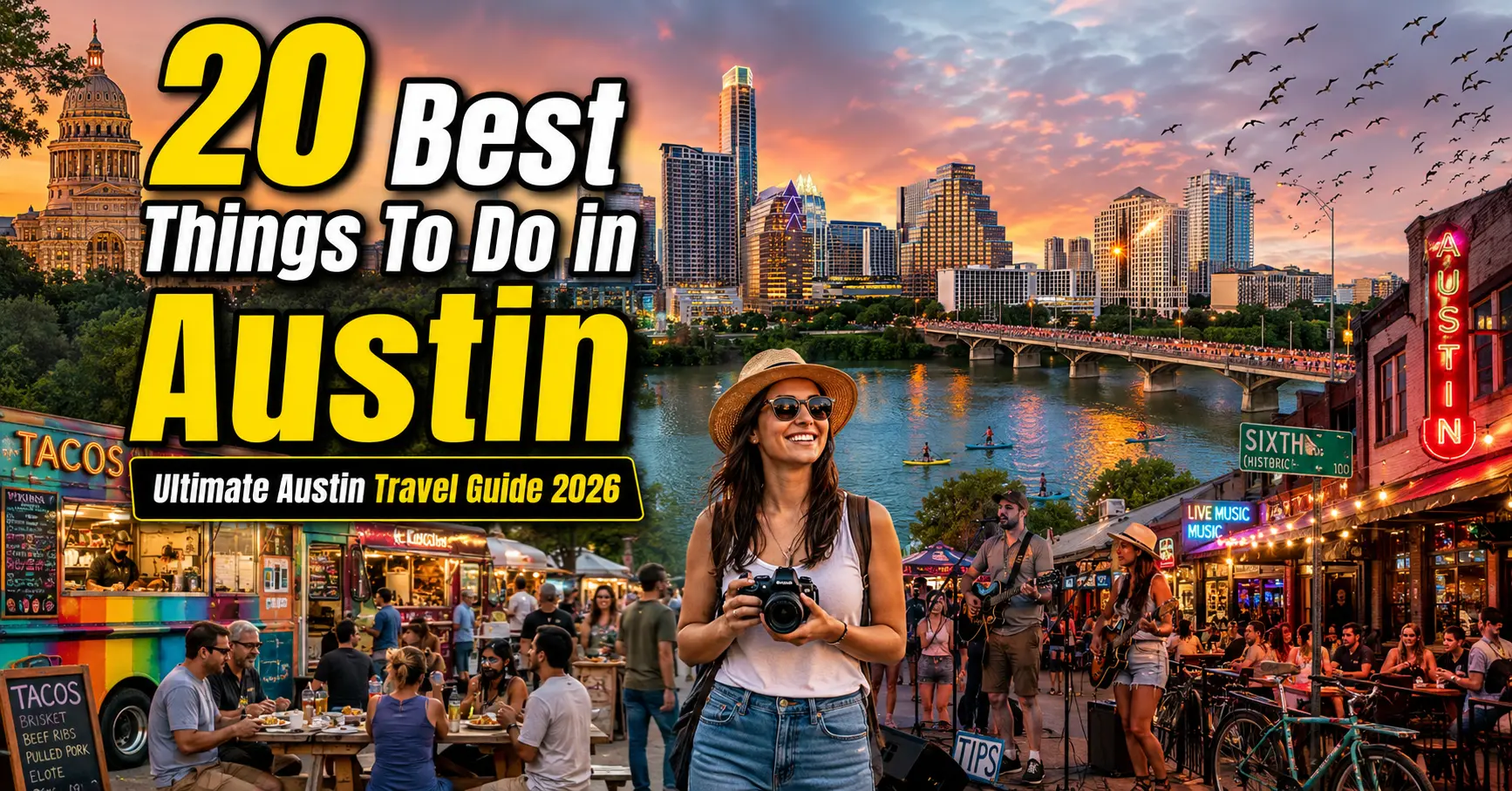
Most cities have a personality. Austin has a whole identity crisis, and that is exactly what makes it one of the most interesting places in America right now.
It is simultaneously a live music mecca, a tech boomtown, a college town, a foodie destination, and a city genuinely committed to staying weird despite everything trying to make it ordinary. Furthermore, the things to do in Austin span an extraordinary range that most travel guides barely scratch.
This guide covers all 20 experiences honestly, with real prices, actual insider tips, and no fluff. In fact, think of it as advice from a friend who lives here rather than a tourist board press release.
What You Will Learn
- The 20 best things to do in Austin Texas across music, food, outdoors, and culture
- Free austin attractions alongside paid experiences worth every dollar
- Neighborhood breakdowns so you know where to spend your time
- Austin Texas activities for families, couples, solo travelers, and food obsessives
- Honest insider tips that most travel guides leave out
- Ready-to-use 1-day, 2-day, and 3-day Austin itineraries
Austin in 2026: Why This City Keeps Getting Better
Austin is the fastest-growing major city in America and has been for the better part of a decade. That growth has brought frustrations for locals but extraordinary benefits for visitors.
The food scene has expanded well beyond its BBQ identity into James Beard-recognized territory. Moreover, the outdoor access remains genuinely remarkable for a city this size, with spring-fed pools, a 10-mile lakeside trail, and a limestone canyon system all sitting within city limits.
Most notably, the music scene that earned Austin its Live Music Capital of the World title has only deepened. In particular, over 250 live music venues means there is genuine world-class talent performing somewhere in this city every single night.
Live Music and Nightlife: The Heart of Austin
No guide to things to do in Austin starts anywhere other than the music. Furthermore, the depth of the live music culture here is the thing that genuinely separates Austin from every other American city claiming a music identity.
1. Sixth Street and the Live Music Corridor
Sixth Street is the most famous entertainment strip in Austin, running from Congress Avenue to IH-35. However, treating all of Sixth Street as one experience misses the point entirely.
Lower Sixth is tourist-facing, loud, and honestly fine for a first night. East Sixth is where Austin locals actually go, with craft cocktail bars, independent music venues, and a block-party atmosphere that feels genuinely spontaneous.
Budget around $5 to $10 for most club cover charges on Sixth Street. That said, arriving before 10 PM on weeknights typically means free entry and a less crowded room.
2. Antone’s and the Continental Club
Antone’s on Fifth Street is Austin’s most legendary blues club with over 50 years of history and a wall of signed photographs that reads like a who’s-who of American music. Furthermore, the Continental Club on South Congress has hosted legends from Stevie Ray Vaughan onward and still books exceptional talent nightly.
Both clubs offer regular free or low-cost shows on weekday nights. In particular, arriving early at the Continental Club secures a spot at the bar before the room fills completely.
3. Austin City Limits TV Show Taping
Austin City Limits is one of the longest-running music shows in American television history. Most notably, the free tickets are distributed through an online lottery approximately one week before tapings, and winners are announced two days ahead.
If the lottery does not go your way, showing up at the venue on taping day sometimes produces surplus tickets. As a result, it is worth trying the lottery first and then showing up anyway if you miss it.
4. White Horse and East Sixth Honky-Tonk Bars
White Horse on East Fifth Street offers two-step dancing, live country music, and genuinely cold Lone Star beer in a bar that feels like it has been there forever. Similarly, Nickel City and Cheer Up Charlies create a rotating block-party atmosphere on summer weekends that draws an interesting mix of long-time Austinites and curious visitors.
The two-step dancing at White Horse is beginner-friendly. Furthermore, the bar runs free lessons before the main evening crowd arrives, which is honestly one of the more charming free things to do in austin texas available on any given night.
Austin Attractions That Earn Their Reputation
Some Austin attractions absolutely justify their fame. Others require managing expectations before you arrive.
5. Congress Avenue Bridge Bat Colony
Between March and late October, 1.5 million Mexican free-tailed bats live under the Congress Avenue Bridge and emerge at sunset every evening to feed. Furthermore, watching this emergence is genuinely one of the most spectacular free events available anywhere in Texas.
Boat tours on Lady Bird Lake provide the best viewing angle, typically running $25 to $35 per person. In particular, visiting on a Tuesday or Wednesday evening avoids the weekend crowds that line the bridge railing shoulder-to-shoulder during peak summer months.
6. Texas State Capitol Building
The Texas State Capitol is taller than the US Capitol in Washington DC, a fact that Texans will mention immediately and often. Free guided tours run daily and cover the remarkable interior dome, the eight-foot-wide Texas star floor mosaic, and the legislative chambers.
Moreover, the surrounding grounds are beautifully maintained and excellent for an early morning walk before the tour groups arrive. That said, the view of the Capitol looking north from South Congress Avenue is one of the finest urban street-level views in Texas and completely free.
7. Blanton Museum of Art
The Blanton is one of the largest university art museums in America and sits on the University of Texas campus within walking distance of the Capitol. Free on Thursdays and reasonably affordable every other day, it consistently rewards visitors who expect a minor regional museum and find something genuinely impressive instead.
In particular, the Ellsworth Kelly chapel on the museum grounds is a piece of architectural and artistic collaboration that stops people mid-step when they first walk inside. Additionally, the permanent collection includes European masters, American modernism, and an exceptional Latin American art section that most visitors overlook entirely.
8. Bob Bullock Texas State History Museum
Three floors cover Texas history from prehistoric times through the present with a theatrical commitment that keeps the storytelling moving. Furthermore, the IMAX theater within the museum runs documentary programming that pairs well with the history exhibits.
Admission is affordable at $13 for adults and the building itself is architecturally impressive enough to justify photographing from the outside before you go in. As a result, it earns a slot on every serious Austin itinerary rather than just the family-with-kids version.
Outdoor Activities in Austin: The City’s Best Competitive Advantage
First-time visitors consistently underestimate Austin’s outdoor scene. Most notably, the combination of spring-fed pools, a lake in the center of downtown, and a limestone canyon system within city limits is genuinely unusual for a major American city.
9. Lady Bird Lake Kayaking and Paddleboarding
Lady Bird Lake is a 416-acre reservoir on the Colorado River running directly through downtown Austin. Kayak and paddleboard rentals start around $20 per hour from multiple access points, with Zilker Park Boat Rentals offering buy-one-get-one coupons on weekdays.
Furthermore, the 10-mile Ann and Roy Butler Hike and Bike Trail circles the entire lake with skyline views throughout. In particular, the section from the South First Bridge east toward the pedestrian bridge provides the finest downtown Austin skyline photography conditions in any lighting.
10. Barton Springs Pool
Barton Springs Pool is a spring-fed natural pool in Zilker Park maintaining a constant 68 to 70 degrees Fahrenheit year-round. Adult entry costs $5 and the pool is large enough that even busy summer weekend afternoons feel manageable.
Moreover, the pool sits within Zilker Park itself, meaning you can combine a morning swim with an afternoon picnic without moving your car. Most notably, the temperature of the water on a 100-degree Austin July afternoon is a genuinely religious experience that locals guard jealously.
11. Barton Creek Greenbelt
The Barton Creek Greenbelt covers 12.86 miles of trails following the creek through limestone canyon country entirely within Austin city limits. Multiple swimming holes are accessible from the trail during wetter periods when the creek runs full.
That said, the greenbelt is at its absolute best during spring and fall when temperatures are manageable and the creek is typically flowing. Similarly, the Sculpture Falls access point on Loop 360 provides the shortest hike to the best swimming hole for visitors with limited time.
12. Pennybacker Bridge Overlook
The Pennybacker Bridge overlook sits on a hilltop parking area above Loop 360 and provides the finest free panoramic view in Austin. Furthermore, the sunset view over Lake Austin in October and November is exceptional in ways that photographs genuinely fail to communicate.
Arriving 20 minutes before sunset secures the prime railing position before the crowd builds. In particular, the rock scramble below the overlook adds a minor adventure element for visitors who want more than a parking lot viewpoint.
Food and Drink in Austin: Beyond the BBQ Queue
Austin’s food scene has matured significantly. Furthermore, while the BBQ remains extraordinary, reducing Austin dining to smoked brisket misses roughly 80 percent of what makes eating here genuinely worth planning around.
13. Franklin Barbecue and the Austin BBQ Pilgrimage
Franklin Barbecue on East 11th Street serves what many serious food critics consider the finest brisket in America. The wait runs two to four hours on a typical weekend morning starting around 9 AM.
That said, arriving at 8 AM with coffee, a folding chair, and genuinely good conversation makes the wait feel less like suffering and more like a cultural ritual. On the other hand, Terry Black’s BBQ on Barton Springs Road offers comparable quality with a significantly shorter queue for visitors who want the brisket without the full pilgrimage commitment.
14. South Congress Avenue Food and Shopping
South Congress Avenue, known locally as SoCo, covers roughly 20 walkable blocks of independent restaurants, boutiques, and the kind of Austin character that new development in other neighborhoods keeps replacing. Home Slice Pizza, Guero’s Taco Bar, and Perla’s Seafood all sit within a three-block stretch.
Furthermore, the Jo’s Coffee mural reading “I love you so much” on the side of the building at 1300 South Congress is one of the most photographed spots in Austin. Most notably, the best time to walk South Congress is Saturday morning before noon when the street is active but parking and crowds are still manageable.
15. East Austin Food and Bar Scene
East Austin has transformed from primarily residential into Austin’s most creative and critically recognized dining district over the past decade. Emmer and Rye, Launderette, and Suerte all represent the James Beard-nominated tier of Austin restaurants concentrated within a walkable East Austin stretch.
Moreover, the bar scene on East Sixth includes craft cocktail bars like Nickel City, natural wine shops, and genuine dive bars all within comfortable walking distance of each other. In particular, spending a Friday evening wandering East Sixth with no reservations and an open mind produces the most authentically Austin experience available.
16. Rainey Street Bar District
Rainey Street is a block of converted 1920s bungalow houses turned into bars and restaurants five minutes south of downtown Austin. More relaxed and slightly more grown-up than Sixth Street, it offers better cocktails at broadly comparable prices with far less chaos.
In particular, Banger’s Sausage House and Beer Garden anchors the block with over 100 draft taps, live music seven nights a week, and a massive outdoor space that makes it one of the most genuinely enjoyable large-format bars in Texas. Furthermore, the bungalow-scale of every other bar on the street creates an intimacy that Sixth Street’s larger venues cannot replicate.
Hidden Austin: Things to Do in Austin Texas That Most Visitors Miss
This is the section that separates the guide you are reading from every generic Austin listicle ranking the same eight attractions in a different order.
17. Hippie Hollow Park
Hippie Hollow is America’s only clothing-optional public park, sitting on Lake Travis approximately 20 miles from downtown Austin. Furthermore, it reflects something genuinely true about the city’s tolerance and outdoor culture that the official tourism materials tactfully omit.
Even visitors who keep their clothes on come for the limestone swimming ledges, the lake access, and the view across Lake Travis that rivals anything the Hill Country offers at higher prices. That said, arriving early on a summer weekend morning beats arriving at noon by a significant margin.
18. Deep Eddy Pool
Built in 1915, Deep Eddy Pool is the oldest swimming pool in Texas and sits near Lake Austin Boulevard, significantly away from the Zilker Park crowds. Moreover, the surrounding lawn is large, flat, and excellent for picnicking before or after swimming.
The adjacent Tacodeli on Oltorf Street is one of the finest breakfast taco spots in Austin, which is a genuine distinction in a city with this much breakfast taco competition. In particular, the Otto taco with potato, egg, and salsa verde costs around $3 and is worth driving across the city to eat.
19. Hope Outdoor Gallery
Hope Outdoor Gallery moved to an eight-acre space near the airport in late 2025, creating the largest outdoor street art installation in Austin’s history. Rotating large-format murals by local and international artists make it genuinely different on each visit.
In particular, the combination of serious public art, open outdoor space, and the characteristic Austin weirdness that produces this kind of civic commitment makes it worth the slightly inconvenient location. Additionally, the new space includes food truck access and shaded areas, which the previous incarnation significantly lacked.
20. Cathedral of Junk
Since 1988, Vince Hannemann has been building a cathedral from salvaged junk in his South Austin backyard. Visits require a text message appointment to a number available on the website and cost absolutely nothing.
Furthermore, it is one of the most genuinely extraordinary things to do in austin texas that no tourist board will ever feature prominently because it resists every attempt to make it commercially presentable. Most notably, it summarizes the Keep Austin Weird spirit more accurately than any official attraction on any official list.
Austin Attractions by Neighborhood: Where to Spend Your Time
| Neighborhood | Best For | Signature Experiences |
| Downtown | History and music | Capitol, Sixth Street, Rainey Street |
| South Congress (SoCo) | Shopping and food | Jo’s Coffee mural, Home Slice, boutiques |
| East Austin | Food and bars | Emmer and Rye, East Sixth, Launderette |
| Zilker Park | Outdoors | Barton Springs, kayaking, Greenbelt |
| The Domain | Shopping | High-end retail, Apple campus, hotel options |
Why South Congress Is the Most Walkable Austin Neighborhood
South Congress covers everything a solid Austin afternoon requires within 20 blocks. Furthermore, the view looking north up Congress Avenue toward the Capitol dome at sunset is one of Austin’s finest free compositions.
Most notably, arriving on a Saturday morning before noon provides the combination of a lively street, manageable parking, and fresh coffee that makes South Congress feel like the Austin you imagined before you arrived. In particular, combining Home Slice Pizza for lunch with Guero’s margaritas in the afternoon covers two Austin institutions in a single afternoon without driving anywhere.
Why East Austin Is Where Austin Is Happening Right Now
East Austin holds the most interesting new restaurants, creative businesses, and bar concepts opening anywhere in the city. Moreover, the neighborhood retains more authentic Austin character than any other area currently because the development arrived later and the community pushed back harder.
That said, East Austin has gentrified significantly over the past decade and the tension between the neighborhood’s origins and its current identity is visible and worth understanding. In particular, eating at local institutions like Joe’s Bakery on East 7th, which has been feeding Austin since 1962, provides context that the newer openings cannot.
Free Things to Do in Austin Texas
Austin’s free experience offering is genuinely strong. Furthermore, this is a city where some of the finest moments cost absolutely nothing.
Genuinely free Austin experiences:
- Congress Avenue bat colony emergence every evening March through October
- Texas State Capitol free guided tours daily
- Ann and Roy Butler Hike and Bike Trail around Lady Bird Lake
- Pennybacker Bridge sunset overlook
- South Congress Avenue browsing and mural photography
- Hope Outdoor Gallery
- Cathedral of Junk (text appointment required)
- Blanton Museum of Art every Thursday
- Barton Creek Greenbelt hiking
The Honest Guide to Keeping Austin Costs Manageable
Accommodation costs in Austin have risen sharply through 2025 and 2026. Budgeting for a hotel further from downtown and using rideshare for evenings out makes the math significantly more comfortable.
Furthermore, most live music covers run $5 to $15 and many shows on weeknights are free before 10 PM. Most notably, breakfast tacos from local taquerias run under $3 each and represent the finest food-to-dollar ratio available anywhere in the city, which is saying something given the overall quality of Austin’s food scene.
Things to Do in Austin Texas With Kids
Best Family-Friendly Austin Attractions
The Zilker Park kite festival in March is one of the finest free family events in Texas, drawing tens of thousands of participants to the park lawn on a weekend afternoon in early spring. Furthermore, the Bob Bullock Museum IMAX suits children old enough to sit for 45 minutes with programming that is accessible and genuinely interesting.
Barton Springs Pool at $3 for children under 12 is the finest summer family activity in Austin without serious competition. In particular, the spring-fed temperature makes it simultaneously refreshing and never uncomfortably cold for young swimmers. Additionally, the Austin Zoo on Circle Drive is a smaller rescue zoo that is more manageable in scale for families with young children than a major metropolitan zoo would be.
Austin Itineraries: How to Plan Your Trip
1-Day Austin Itinerary: The Essential First Visit
- 8 AM: Breakfast tacos at Joe’s Bakery on East 7th, Austin institution since 1962
- 10 AM: Texas State Capitol free guided tour
- 12 PM: Lunch at Guero’s Taco Bar on South Congress
- 2 PM: Browse South Congress boutiques and photograph the Jo’s Coffee mural
- 4 PM: Kayak on Lady Bird Lake, return boards by 6 PM
- 7 PM: Dinner on Rainey Street
- 9 PM: Live music on East Sixth Street
Furthermore, this single-day itinerary covers Downtown Austin, South Congress, and Lady Bird Lake without requiring a car between stops. Most notably, ending on East Sixth rather than lower Sixth gives a first-time visitor a genuinely Austin evening rather than a generic bar district experience.
2-Day Austin Itinerary: Going Deeper
Day 1: Full 1-day itinerary above
Day 2:
- 8 AM: Franklin Barbecue queue with coffee and something to read
- 12 PM: Barton Springs Pool in Zilker Park for afternoon recovery
- 4 PM: Zilker Park picnic and walking
- 7 PM: Antone’s or Continental Club for live music
Moreover, this two-day plan covers the most essential Austin food pilgrimage alongside the finest outdoor experience the city offers. As a result, most visitors who do both days leave feeling like they genuinely understood Austin rather than just passed through it.
3-Day Austin Itinerary: The Full Experience
Day 1: Downtown, Capitol, South Congress, Rainey Street at night Day 2: East Austin food tour, Barton Springs Pool, East Sixth Street evening Day 3: Lady Bird Lake kayak morning, Pennybacker Bridge at sunset, Congress Avenue bat emergence at dusk
In particular, structuring Day 3 around the sunset and bats creates a genuinely spectacular final evening that no amount of ordinary sightseeing can match. Furthermore, the bat emergence at sunset on the Congress Avenue Bridge after a day on the water is one of those travel moments that people describe to other people for years afterward.
Best Time to Visit Austin Texas
| Season | Experience | What to Expect |
| Spring Mar to May | Best overall | SXSW in March, wildflowers, comfortable temperatures |
| Summer Jun to Aug | Hot but fun | Barton Springs essential, evening events, extreme heat |
| Fall Sep to Nov | Strong second choice | ACL Festival in October, cooling temperatures |
| Winter Dec to Feb | Quiet and affordable | Lower prices, mild weather, smaller crowds |
Why March Is Austin’s Most Electric Month
The SXSW Film and Music Festival in March fills every venue, street corner, hotel room, and coffee shop in the city with creative industry professionals from every corner of the world. Furthermore, bluebonnet wildflower season begins in late March across the surrounding Hill Country, adding a landscape dimension that transforms day trips out of the city.
Most notably, restaurant and bar reservations during SXSW require advance booking weeks ahead and accommodation prices reach their annual peak. That said, the energy of the city during SXSW week is unlike anything Austin produces at any other point in the year and worth experiencing at least once.
Why October Rivals March for Best Austin Month
Austin City Limits Music Festival turns Zilker Park into a two-weekend world-class outdoor concert across two October weekends with lineups that compete with any festival in America. Furthermore, temperatures drop to genuinely pleasant levels after the brutal summer heat, making outdoor activity suddenly comfortable again.
As a result, October is the single best month for first-time visitors who want outdoor activity, live music, and comfortable weather simultaneously. Most notably, accommodation and restaurant availability outside the ACL Festival weekends themselves is excellent and prices reflect the shoulder season rather than the peak.
Practical Tips Before Your Austin Trip
Getting Around Austin
Austin has limited public transit and a car or rideshare is the practical choice for most visits covering multiple neighborhoods. However, Downtown, South Congress, and East Sixth are all individually walkable once you are in the neighborhood.
Rideshare from Austin-Bergstrom International Airport to Downtown runs approximately $25 to $35 depending on time of day and surge pricing. That said, arriving on a Sunday afternoon rather than Friday evening cuts that cost significantly and avoids the worst airport congestion.
Where to Stay in Austin
Downtown hotels are convenient but expensive, particularly during SXSW and ACL Festival weeks when prices can triple. Furthermore, South Congress boutique hotels like Hotel San José and the Austin Motel offer genuine character at prices that feel reasonable relative to what Downtown charges for considerably less personality.
East Austin Airbnbs provide the best neighborhood immersion for travelers who want the genuine local feel rather than a hotel lobby experience. Most notably, the proximity to the East Sixth bar scene and the best East Austin restaurants makes an East Austin base genuinely practical for evening-focused visitors.
Austin Weather Reality Check
Summer temperatures regularly exceed 100 degrees Fahrenheit and the humidity adds an additional layer of misery that the numbers alone do not communicate. Carrying water everywhere between June and September is not a suggestion but a genuine survival strategy.
That said, Barton Springs Pool, Deep Eddy Pool, Lady Bird Lake, and the Barton Creek Greenbelt swimming holes make Austin summer genuinely survivable in ways that reward visitors who plan around the heat rather than against it. In particular, structuring summer days to finish outdoor activity by noon and return for evening activity after 6 PM produces the most enjoyable Austin summer experience.
Conclusion
Things to do in Austin span an extraordinary range that genuinely rewards every type of traveler who shows up with even minimal curiosity. The live music is as real as advertised, the food has outgrown its BBQ origins into something genuinely serious, and the outdoor access within city limits remains one of the most pleasant surprises of any first Austin visit.
Furthermore, the weirdness is real too. Cathedral of Junk, Hippie Hollow, Chicken Sh*t Bingo at Little Longhorn Saloon on Sunday afternoons, the hearse ghost tour, the speakeasy behind the Driskill Hotel Austin produces genuinely unusual experiences that most American cities have long since bulldozed in favor of something more photogenic and less interesting.
Pick three things to do in Austin Texas from this guide that genuinely appeal to you. Build your days around those three rather than trying to check every box. In fact, the best Austin trips happen when the list gets abandoned around 4 PM on the second day and you end up somewhere completely unexpected with a cold Lone Star and no particular plan. That is the city working as intended.