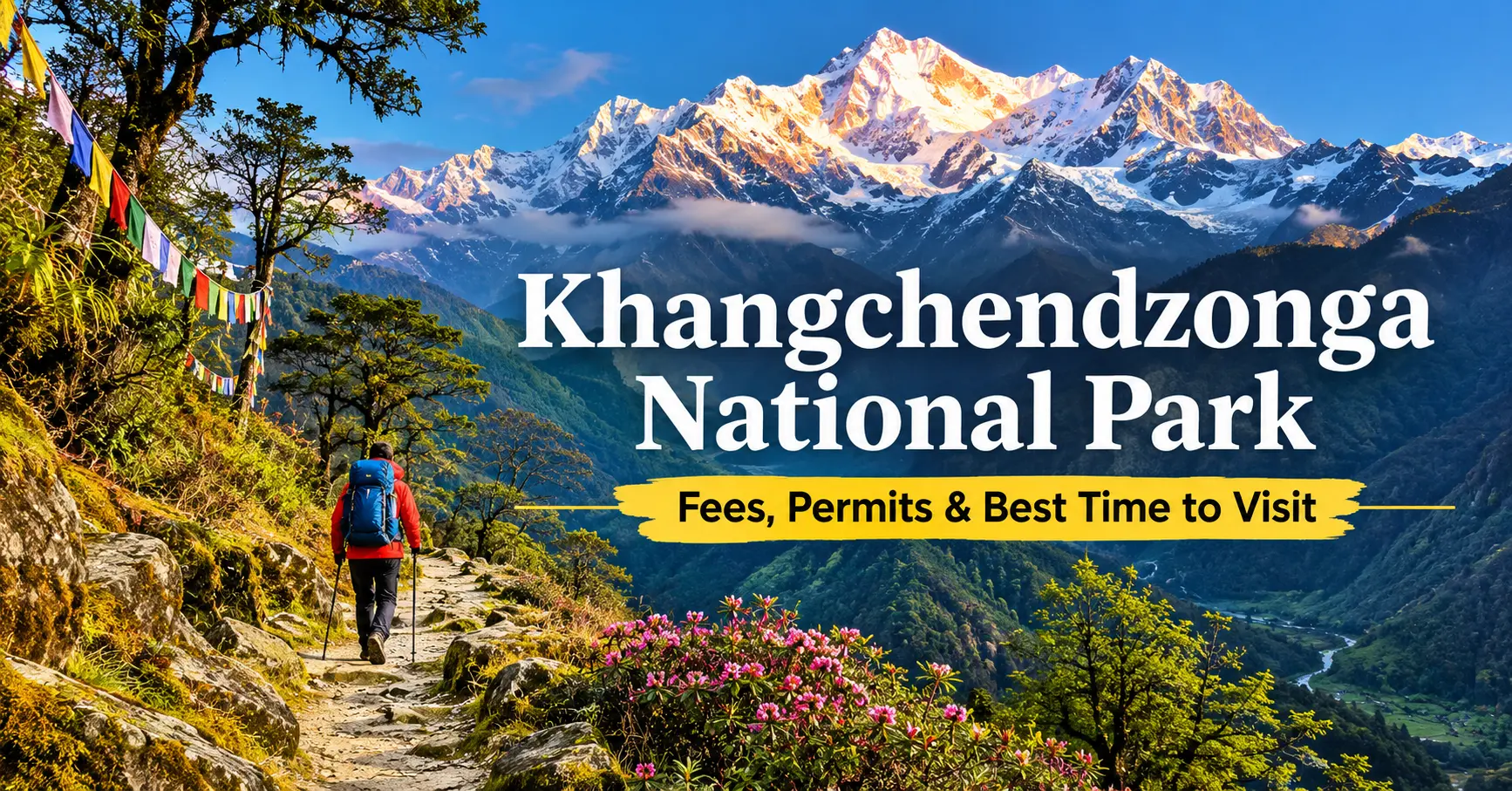
Khangchendzonga National Park is a 1,784 km2 protected area in Sikkim, India, and a UNESCO World Heritage Site. Visitors reach it through Pelling, Yuksom or Lachen.
This guide covers the entry fee, permits, best time, routes and the Goechala trek. It also flags where sources disagree, so you can plan with accurate expectations.
Spellings vary, and you will also see Kanchenjunga National Park. However, fees, hours and permit rules change, so confirm them with the Sikkim Forest Department before you travel.
Key Takeaways
- The park covers 1,784 km2 in Mangan and Gyalshing districts, Sikkim.
- UNESCO inscribed it in July 2016 as India’s first mixed site.
- Reported Indian entry fees run from ₹200 to ₹350, so verify before paying.
- Spring and autumn are the usual best seasons for visitors.
- The Goechala trek takes about nine days and is strenuous.
- Trek permits normally go through a registered operator, and a guide is mandatory.
Khangchendzonga National Park at a Glance
Use this table for quick planning. Figures come from Wikipedia, Incredible India and travel guides, so verify the fees and timings before you go.
| Item | Detail |
| Location | Mangan and Gyalshing districts, Sikkim |
| Area | 1,784 km2 |
| Altitude | 1,829 m to over 8,550 m |
| UNESCO listing | July 2016, mixed site |
| Centrepiece | Mount Khangchendzonga, third-highest peak in the world |
| Glaciers and lakes | 18 glaciers and 17 alpine lakes |
| Gateway town | Pelling, with Yuksom for the trek |
| Nearest airports | Bagdogra and Pakyong |
| Nearest railway station | New Jalpaiguri |
| Suggested stay | About 2 nights and 3 days for a short visit |
What Is Khangchendzonga National Park?
The park protects a large block of the eastern Himalaya in north and west Sikkim. It rises from forested valleys to glaciers beneath Mount Khangchendzonga.
Mount Khangchendzonga is the third-highest mountain on Earth. Incredible India calls it the centrepiece of the park, with about 19 Himalayan peaks inside the boundary.
Wikipedia lists Chungthang as the nearest town. Most tourists, however, base themselves in Pelling or Yuksom in the west, because those towns have the stays and trek access.
Why It Is a UNESCO Mixed Site
UNESCO inscribed the park in July 2016 at its 40th session, under reference 1513. According to Wikipedia, it was the first mixed heritage site in India.
Mixed status means the site meets both natural and cultural criteria. Wikipedia lists criteria iii, vi, vii and x for the park.
The cultural side comes from the mountain’s sacred role for local communities. TravelTriangle describes Khangchendzonga as the “abode of the gods”, so treat the peak and its lakes with respect.
Our advice: read the park rules before you go. Sacred sites often restrict noise, litter and loud behaviour, and guides will explain local customs.
For other protected places across the country, including natural and cultural sites, see our full guide to UNESCO World Heritage Sites in India.
Khangchendzonga National Park Entry Fee and Permits
Entry fees are the least consistent detail in the research. Two travel guides quote different figures, and we could not open an official fee notice.
| Visitor | MakeMyTrip | TravelTriangle |
| Indian visitor | ₹200 | ₹350 for the first 7 days, then ₹40 a day |
| Foreign visitor | ₹400 | ₹560 for the first 7 days, then ₹80 a day |
| Indian student | Not listed | ₹80 for the first 7 days, then ₹20 a day |
TravelTriangle also lists smaller charges. A tent costs ₹50 per day, a log hut bed costs ₹100 per day, and a still camera costs ₹30.
It lists ₹1,000 for a video camera and ₹10 per day for local guides and porters. Treat these as reported figures, not confirmed rates.
How Do Permits Work?
Under the Wildlife (Protection) Act, 1972, the Chief Wildlife Warden grants visitor permission on payment of the listed fees. TravelTriangle explains this for photography and tourism.
High-altitude climbing and expeditions need separate permission from the Government of Sikkim, according to the same guide. A casual day visitor, however, will not need that.
For the Goechala trek, Northeast Tours Packages says park permits are mandatory and go through a registered trek operator. Only operators can apply, so individual trekkers cannot book alone.
The same guide says processing takes one to two working days for Indian trekkers. Foreign trekkers should allow three to four working days.
Trek in Sikkim says the Inner Line Permit and Yuksom police registration are included in operator packages. We could not confirm the Inner Line Permit rules from an official source.
Our advice: ask your operator exactly which permits they arrange, and request copies of every document before you reach Yuksom, so nothing is missing at the check post.
Park Timings
Sources disagree on timings. Incredible India lists the park as open all day, while MakeMyTrip lists 10 am to 6:30 pm.
TravelTriangle lists 24 hours from Monday to Saturday with Sunday closed, then contradicts itself in its FAQ. For that reason, confirm the hours at the entry point.
Best Time to Visit Khangchendzonga National Park
Spring and autumn are the usual recommendations. MakeMyTrip and TravelTriangle list March to May and September to mid-December for general visits.
Trekkers should follow a narrower window. Northeast Tours Packages give April to May and October to November for the Goechala route.
| Season | What to expect |
| April to May | Rhododendron blooms, with more cloud later in May |
| June to September | Monsoon, leeches, landslides and possible trail closures |
| October to November | Clearest mountain views and colder temperatures |
| Winter | Heavy snowfall, according to MakeMyTrip |
Snow can close Goechala Pass in November, and late snow is possible in early April. Therefore, check conditions with your operator before you book flights.
Trek in Sikkim describes the 2026 trek season as May to December. This is wider than the other guide, so verify the dates with your operator.
How to Reach Khangchendzonga National Park
You reach the park by road from Sikkim and North Bengal. The usual gateways are Pelling and Yuksom for the western side, and Gangtok for the north.
| Mode | Option |
| Air | Bagdogra International Airport (IXB) or Pakyong Airport (PYG) near Gangtok |
| Rail | New Jalpaiguri (NJP) |
| Road | National Highway 31A, then a taxi from Gangtok or a shared jeep |
Sources name both Bagdogra and Pakyong as the nearest airport. Pakyong has fewer flights, so Bagdogra is the practical choice for most travellers.
TravelTriangle gives conflicting Bagdogra distances, listing 122 km in one section and 222 km in another. We do not quote either, so check a map.
Roads in Sikkim can close during heavy rain. Allow a buffer day before your trek, and book your onward transport with a trusted driver.
Goechala Trek: What to Know Before You Go
The Goechala (Goecha La) trek is the best-known route into the park. It starts at Yuksom, at about 1,780 m, and climbs to a pass at about 4,600 m.
| Detail | Reported figure |
| Distance | About 90 km round trip |
| Duration | About 9 days, up to 11 with extra days |
| Highest point | Goechala Pass, about 4,600 m |
| Difficulty | Strenuous |
| Starting point | Yuksom |
Typical Route
Northeast Tours Packages describes a standard nine-day plan. The route passes through forest, then climbs through high camps before the final push to the pass.
- Yuksom to Sachen, about 8 km.
- Sachen to Tshoka, about 7 km.
- Tshoka to Dzongri, about 9 km.
- Acclimatisation day at Dzongri.
- Dzongri to Thansing, about 10 km.
- Thansing to Lamuney, about 4 km.
- Lamuney to Goechala Pass and back to Thansing, about 16 km.
- Thansing to Tshoka, about 19 km.
- Tshoka to Yuksom, about 15 km.
The summit push starts around 2:30 to 3:00 am, according to the same guide. Therefore, pack a headlamp and warm layers.
Trek Cost and Rules
Reported costs vary by operator. Trek in Sikkim quotes ₹19,000 to ₹30,000 across the market, and a ₹24,000 package from its own operator.
Northeast Tours Packages gives a wider range of roughly ₹18,000 to ₹38,000, from budget to premium operators. Compare inclusions before you compare prices.
Packages usually include guides, cooks, tents and permits. Flights or trains to Bagdogra or New Jalpaiguri are not included, according to Trek in Sikkim.
A guide is mandatory on this route. Northeast Tours Packages adds that the guide can turn trekkers back if they show altitude symptoms.
Trek in Sikkim says foreign nationals must trek in a group of at least two. This appears on one page only, so confirm it with your operator.
Altitude Safety
The route stays above about 4,270 m (14,000 ft) for three days, and acute mountain sickness is the main risk. Take the acclimatisation day seriously.
Descend if symptoms worsen. Our advice: choose an operator that carries a pulse oximeter and emergency oxygen, and rent a sleeping bag rated to at least -10°C.
Wildlife and Landscape
The park has a wide range of habitats. Wikipedia describes temperate broadleaf and mixed forests of oak, fir, birch, maple and willow in the lower zones.
Alpine grasses, shrubs and medicinal plants grow higher up. Above them, 18 glaciers feed the valleys, including the Zemu Glacier, which Incredible India lists at about 26 km.
| Group | Examples |
| Big cats | Snow leopard, clouded leopard, Indian leopard, Asian golden cat |
| Other mammals | Red panda, Himalayan wolf, Himalayan tahr, bharal |
| Birds | Blood pheasant, satyr tragopan, lammergeier |
| Also recorded | Dhole, on camera traps between 2,501 m and 4,100 m |
Wikipedia reports six cat species and about 550 bird species. Snow leopards and red pandas are rarely seen, so treat them as a bonus.
Our advice: carry binoculars and warm clothing. MakeMyTrip also lists water, snacks and a first-aid kit, and it bans plastic and loud music.
Things to Do Around the Park
Trekking is the main activity, but short visits work too. Pelling and Yuksom both offer valley walks, birdwatching and monastery stops.
MakeMyTrip lists a trek to Green Lake via Lachen village, Tholung Monastery and sunset photography. TravelTriangle adds Khecheopalri Lake and the Yuksom valley.
Nearby attractions in Sikkim include Rumtek Monastery, Tsomgo Lake and Nathu La Pass, according to MakeMyTrip. For a wider plan, read our guide to places to visit in Sikkim.
Where to Stay
Pelling is the usual base for non-trekkers, and Yuksom suits trekkers because the Goechala route starts there. Both towns have hotels and homestays.
TravelTriangle lists forest rest houses, homestays and budget hotels for the park area. Rest houses may need prior permission, so ask the forest office first.
On the trek, tented camps and trekkers’ huts replace hotels. Your operator arranges these, and tent pitching has its own reported fee.
Suggested Trip Lengths
Match your plan to your time and fitness level. The table below separates a short valley visit from the full Goechala trek.
| Plan | Time | Best for |
| Pelling and Yuksom valley visit | 2 nights, 3 days | Families and casual visitors |
| Short trek to Dzongri | About 4 to 5 days | Fit beginners who want high-altitude views |
| Goechala trek | 9 to 11 days | Experienced high-altitude trekkers |
The Dzongri option is our suggestion, built from the route stages above. Confirm duration with an operator, because we found no separate source for it.
Details We Could Not Verify
We could not open the UNESCO page, so inscription details come from Wikipedia. Likewise, no official fee notice was available, so every price below needs a check.
| Item | What sources say | Our approach |
| Indian entry fee | ₹200 (MakeMyTrip) or ₹350 for 7 days (TravelTriangle) | Show both |
| Foreign entry fee | ₹400 (MakeMyTrip) or ₹560 for 7 days (TravelTriangle) | Show both |
| Foreign trek permit | About ₹5,000 at the check post, or included (Trek in Sikkim) | Ask your operator |
| Timings | Open all day, 10 am to 6:30 pm, or closed Sundays | Verify at entry |
| Bagdogra distance | 122 km or 222 km (TravelTriangle) | Not quoted |
| Park elevation | 1,829 m (Wikipedia) or 1,220 m (TravelTriangle) | Use Wikipedia |
| Trek season | April to May and October to November, or May to December | Give both |
Final Thoughts
Khangchendzonga National Park suits both short visitors and serious trekkers. Choose your plan by time, fitness and season, and book a registered operator for the trek.
Before you go, confirm fees, timings and permits with the Sikkim Forest Department. Moreover, build a buffer day into your schedule for weather and road delays.